

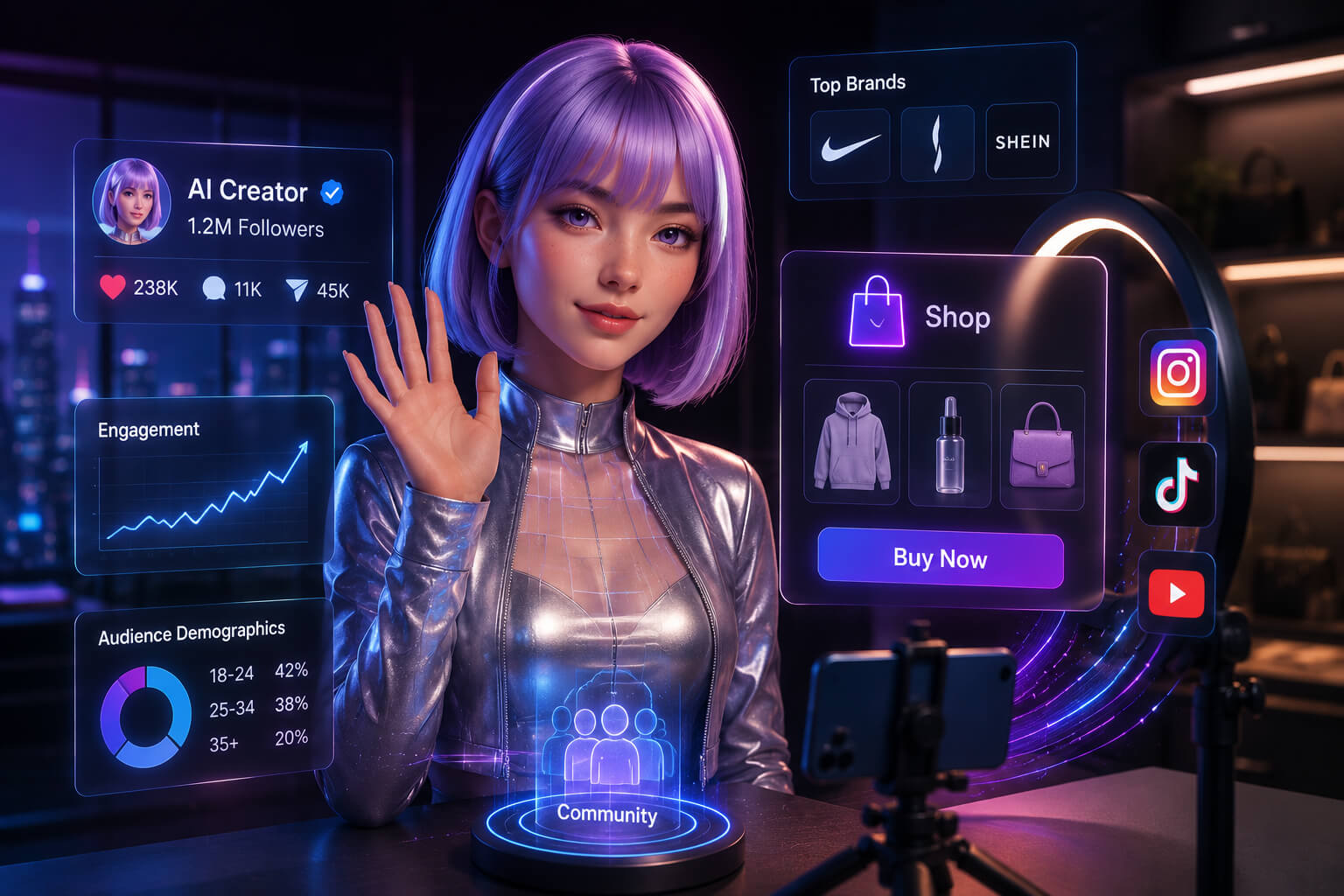
AI influencers are quickly becoming one of the biggest disruptions in the creator economy, changing how brands think about influence, content production, and digital commerce.
What once looked like a futuristic idea is now becoming a serious business model. Virtual personalities are building audiences, attracting brand interest, and competing for marketing budgets that once went almost entirely to human creators.
As artificial intelligence becomes more advanced, the creator economy is moving into a new phase where human creators, AI-generated personalities, AI studios, and social commerce tools are all becoming part of the same ecosystem.
The Rise of AI Influencers
AI influencers are digital personalities created using artificial intelligence. They can appear in lifestyle posts, fashion campaigns, travel content, product promotions, and social media videos without ever physically existing.
One example gaining attention is Vrutika Patel, an AI-generated Instagram influencer who has reportedly gained more than 100,000 followers and over 300 paid subscribers. With subscriptions priced at ₹390 per month, the account is estimated to generate more than ₹1.17 lakh in monthly subscriber revenue.
Her content looks similar to that of a traditional lifestyle influencer, featuring travel, fashion, café visits, and aspirational moments. The major difference is that the visuals and interactions are created using AI.
This shows how quickly virtual creators are moving from novelty accounts to monetised digital personalities.
Why Brands Are Interested in AI Influencers
For brands, the appeal of AI influencers is clear. Unlike human influencers, virtual creators do not need travel arrangements, photoshoot schedules, availability checks, or personal reputation management.
They can be customised for specific audiences, adapted for different languages, and designed to match a brand’s identity. They can also post consistently and be available for campaigns at any time.
This gives brands greater control over messaging, visual style, and campaign execution.
AI influencers also allow companies to create their own digital brand ambassadors. Instead of renting attention from a human creator, brands can build virtual personalities they fully own and manage.
AI Influencers Are Competing for Marketing Budgets
The rise of AI influencers is beginning to affect influencer marketing budgets.
For years, brands spent heavily on human creators across nano, micro, mid-tier, and macro influencer categories. Now, virtual influencers are entering the same budget conversations.
AI-generated creators can offer cost efficiency, scalability, and consistent campaign delivery. This makes them attractive to brands that want more control over performance and production timelines.
However, this shift also creates concern for human creators, especially those in the mid-tier and micro-influencer segments. As AI creators become more realistic and affordable, some brands may choose virtual personalities for campaigns that previously relied on human influencers.
AI Studios Are Powering the Next Creator Economy
Behind every AI influencer is a growing production system known as an AI studio.
AI studios use artificial intelligence to create visuals, videos, scripts, voices, digital environments, translations, and campaign variations at scale. These studios are changing how content is produced for social media, advertising, and creator commerce.
Instead of relying on large teams and long production timelines, brands and agencies can now create multiple content versions faster and more cost-effectively.
This is especially important for markets like India, where multilingual content, regional campaigns, and platform-specific formats are becoming more important for growth.
AI studios are not only helping brands create virtual influencers. They are also helping human creators and agencies scale content production across Reels, Shorts, ads, product campaigns, and social commerce experiences.
Platforms Are Building AI Commerce Tools
Social media platforms are also accelerating the shift toward AI-powered creator commerce.
Meta has introduced tools that allow creators to add product links directly into Reels, making creator content more shoppable. Brands can also share product catalogues with creators, helping them integrate products more easily into content.
At the same time, Meta is expanding generative AI tools for content creation, localisation, avatar-based videos, and AI-powered translations.
These features show how platforms are moving toward a future where content, commerce, AI, and influencer marketing are tightly connected.
For creators, this means more tools to monetise content. For brands, it means easier ways to turn creator campaigns into measurable sales channels.
Human Creators Are Using AI to Compete
While AI influencers are gaining attention, human creators are also using AI to become more competitive.
Many creators now use AI tools to generate content ideas, write captions, analyse audience comments, study engagement patterns, prepare brand pitches, and improve campaign strategy.
Instead of replacing human creators entirely, AI is becoming a productivity tool for creators who want to work faster and make better business decisions.
For example, creators can use AI to understand what brands look for in campaign metrics, identify trending formats, or repurpose one piece of content into multiple platform-ready versions.
This allows human creators to compete more effectively in a crowded market.
The Trust Challenge for AI Influencers
As AI influencers become more realistic, transparency is becoming a major issue.
Audiences need to know when they are interacting with a real person, a virtual influencer, or content that has been created or enhanced using artificial intelligence.
Regulators and advertising bodies are beginning to respond with disclosure guidelines for AI-generated advertising content. These rules are expected to require brands and creators to clearly label synthetic content, virtual influencers, and AI-enhanced campaigns.
This is important because trust remains one of the most valuable assets in the creator economy.
If audiences feel misled, brands may face backlash. Clear disclosure can help protect consumer trust while still allowing innovation in AI-powered influencer marketing.
What AI Influencers Mean for the Future of Creator Marketing
AI influencers are not just another social media trend. They represent a larger shift in how content, commerce, and influence are being created.
The creator economy is now being shaped by three major forces: generative AI, social commerce, and platform monetisation.
Virtual creators can build audiences. Human creators can use AI to improve performance. AI studios can produce content at scale. Platforms can connect creator content directly to shopping and advertising tools.
Together, these changes are pushing the industry toward a more synthetic, automated, and commerce-driven future.
Will AI Replace Human Influencers?
AI influencers may take a growing share of brand budgets, especially for campaigns where control, consistency, and scalability matter most.
However, human creators still have strengths that AI cannot fully replace. Authentic personal experience, emotional connection, lived expertise, humour, trust, and community relationships remain powerful advantages.
The future of influencer marketing is likely to include both human and AI creators.
Brands may use AI influencers for scalable content, product-led storytelling, and controlled brand campaigns. At the same time, they may continue to work with human creators for authenticity, community engagement, and trust-based recommendations.
The Creator Economy Is Entering a New Era
The rise of AI influencers, AI studios, and AI commerce shows that the creator economy is entering a major new era.
For creators, the message is clear: AI is no longer optional. It is becoming part of the toolkit for content strategy, production, audience analysis, and monetisation.
For brands, AI offers new ways to build digital personalities, scale campaigns, and connect content directly to sales.
For audiences, the biggest question will be transparency. As virtual influencers become more common, clear labelling and responsible content practices will be essential.
AI influencers are changing what it means to be a creator. The next stage of the creator economy will not be defined only by people with cameras, but also by digital personalities, AI-powered studios, and platforms that turn influence into commerce.
