

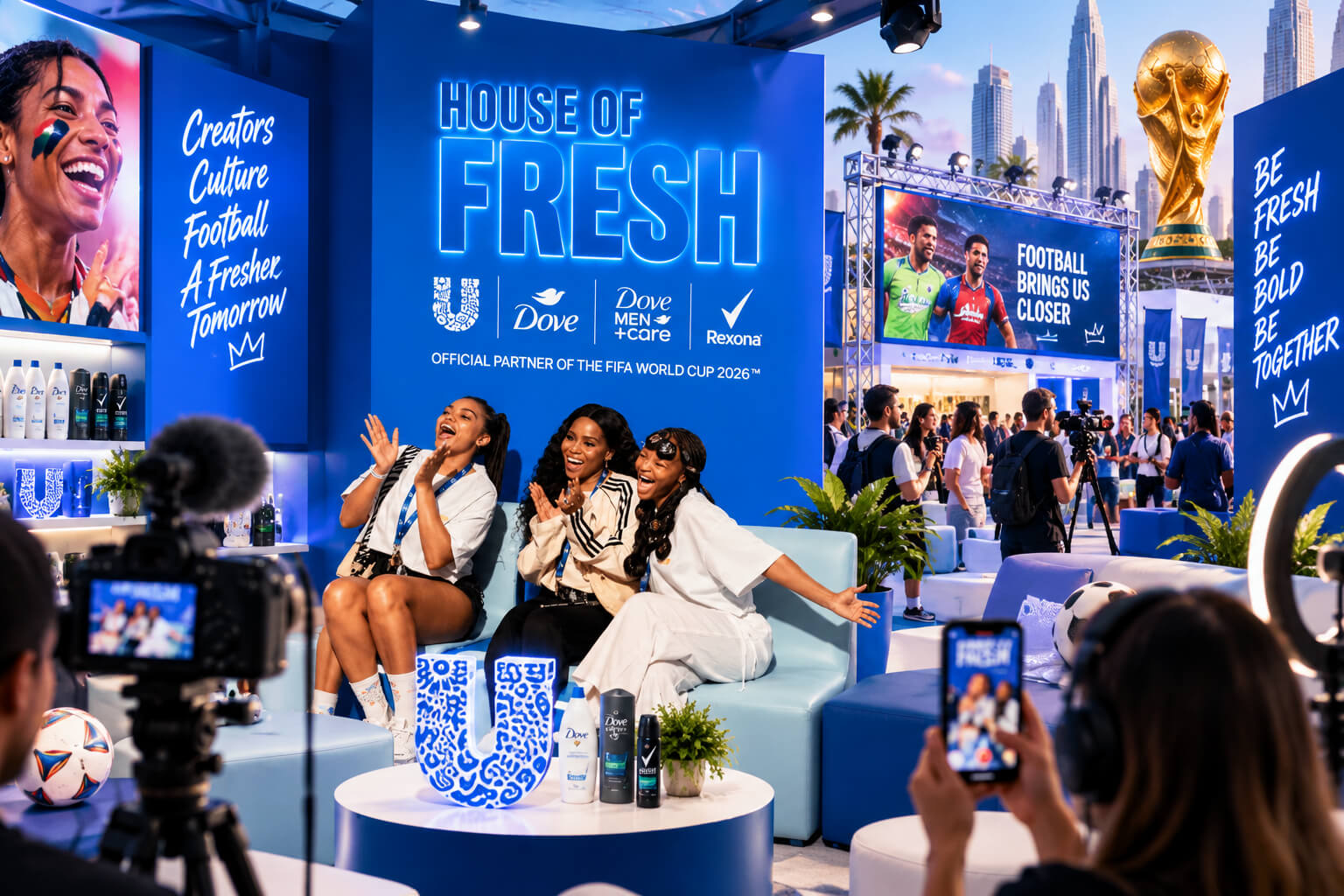
Unilever went into the FIFA World Cup 2026 with something bigger than another sports sponsorship in mind. It wanted creators making content while the tournament was actually happening, not days later after a polished campaign had already passed through layers of approval.
That idea became House of Fresh, a network of creator-focused experiences in Mexico, New York and Miami. More than 2,100 creators and sports personalities took part in the activations, producing around 6,000 pieces of content and generating a reported 2.5 billion in reach. Unilever described House of Fresh as the largest in-person influencer event it had staged.
The numbers are large, but the more interesting part is how Unilever got there. Creators were not simply invited into a branded room and handed a posting brief. The spaces themselves were designed to give them something worth filming.
House of Fresh Was Built Around the Camera
House of Fresh, known as Casa Fresh in Mexico, operated across three World Cup host cities and was designed with content production in mind from the beginning. Instead of treating social media as something that would happen after the event, Unilever made the physical experience part of the content strategy. Creators could produce personalized football stickers inspired by collectible cards, customize jerseys, build charm bracelets and shoot content around an LED football pitch. Sports personalities including Roberto Carlos, Daniel Sturridge and Marshawn Lynch also appeared at the activations, while smaller nano creators were invited alongside better-known personalities.
That mix gave Unilever a wider range of voices and audiences. According to the company, the activation reached a peak engagement rate of 16%, compared with the 5% industry benchmark cited by Unilever. Sarah Potter, Influencer & Media Director for Unilever Personal Care, described House of Fresh as a content engine rather than a traditional branded event, and that distinction shaped almost every part of the campaign.
Dove, Rexona and Axe Had Their Own Reasons to Be There
House of Fresh acted as the umbrella, but Unilever did not force all of its brands into the same type of activation. Dove, Dove Men+Care, Rexona and Axe each used the spaces differently, which helped the content feel less repetitive. Rexona brought gaming and five-a-side football into its New York Sweat Club, while Dove created a Confidence Arcade that combined football choreography with conversations about body confidence and girls staying involved in sport.
Dove Men+Care focused more on the emotions and rituals surrounding match day, while Axe took a completely different approach by allowing creators to work with a scent expert and develop customized fragrances. That variety mattered because the campaign could easily have become a collection of nearly identical branded experiences. Instead, each Unilever brand had a reason to exist within the wider World Cup setting, which gave creators more material to work with and made the resulting content feel less templated.
Unilever Didn’t Force Creators to Tag the Brands
One of the more unusual decisions involved what Unilever chose not to require. Creators attending the activations generally were not forced to tag Unilever brands in every piece of content. The company instead built branding into the environment and trusted creators to capture it naturally while filming their own experiences.
Potter said most of the resulting content was organic, with some creators reportedly beginning to record almost immediately after entering the spaces. That approach shifts the usual relationship between brands and influencers. Rather than controlling every caption, tag and talking point, Unilever invested more heavily in creating moments that creators would actually want to share. A detailed brief can guarantee brand mentions, but it cannot guarantee that viewers will care about the post.
The Campaign Didn’t Stop at Reach
The reported 2.5 billion reach figure grabbed the most attention, but Unilever also connected the creator campaign with commerce. Amazon partner creators produced shoppable content around limited-edition products linked to the World Cup campaign, giving the company a way to move from visibility into product discovery and purchasing.
According to Potter, that shoppable creator content generated five times the reach of traditional brand advertising. Unilever also introduced more than 180 limited-edition products across its wider World Cup program and distributed them through millions of retail locations. Data and AI-driven forecasting reportedly helped coordinate product availability across markets. The creator strategy therefore sat inside a much larger commercial operation, where physical experiences, social media, retail and commerce all fed into the same campaign.
House of Fresh Was Only One Piece of a 50,000-Creator Strategy
The more than 2,100 creators who attended the physical hubs represented only a fraction of Unilever’s World Cup creator strategy. The company planned to work with more than 50,000 creators across over 120 markets, covering more than 35 Personal Care brands during the tournament.
That creator pool stretched far beyond football personalities. Unilever worked with people across sports, beauty, lifestyle, fashion and other interest areas, allowing the campaign to reach audiences that may not normally interact with conventional World Cup advertising. The strategy turned a global sporting event into a broader cultural content opportunity rather than treating football fans as the only audience worth targeting.
The Locker Room Added a Real-Time Publishing Layer
Behind the physical creator hubs, Unilever also built a separate social content operation called The Locker Room. The 24/7 hub brought together creators, football strategists and community specialists who could react to matches, viral moments and tournament conversations as they happened.
That gave the company a way to produce content for platforms such as TikTok and YouTube without waiting for long campaign approval cycles. Unilever’s AI Content Studio and Social Studios reportedly supported the wider effort as well, producing more than 18,000 assets across 120 multi-brand and multi-market campaigns. The scale starts to look less like a traditional sponsorship and more like a temporary global publishing network.
Creators Are Moving Deeper Into Unilever’s Marketing Budget
House of Fresh also fits into a much larger shift in how Unilever is spending its advertising budget. CEO Fernando Fernandez said in 2025 that the company wanted to move 50% of its advertising spend into social media while significantly increasing the number of influencers working with its brands.
Influencer marketing’s share of spending was expected to rise from roughly 30% to 50%, and the World Cup became a huge testing ground for that strategy. Traditional advertising and sponsorship rights still had a role, but creators were moved much closer to the center of the campaign. Unilever was not simply buying attention from influencers. It was building an infrastructure designed to generate thousands of different stories around the same event.
Small Creators Had a Place Beside Big Sports Names
Unilever’s creator mix also included nano and micro creators alongside celebrity names and major sports personalities. That gave the campaign two very different types of reach. Larger creators could generate immediate visibility, while smaller creators could bring the campaign into more specific communities where recommendations may feel more personal.
This is an important part of the strategy because follower count alone does not determine how influential a creator can be. Smaller creators often have tighter relationships with their audiences, and when enough of them participate in the same campaign, their combined effect can rival or exceed the impact of a few celebrity endorsements. Unilever appeared to understand that scale can come from volume and relevance, not just from individual follower numbers.
Unilever Wants to Use the Formula Again
House of Fresh is not being treated as a one-off World Cup experiment. Unilever is already looking at how the model can be reused for future FIFA events, including the FIFA Women’s World Cup 2027 in Brazil.
That matters because the value of House of Fresh may not be the 2.5 billion reach figure alone. The larger opportunity is that Unilever now has a repeatable framework combining creators, physical experiences, social production, retail, commerce and rapid-response content. A one-off influencer event can generate a weekend of posts. A repeatable system can become part of how a multinational brand launches campaigns across dozens of countries.
What Unilever’s 2.5 Billion Reach Says About Creator Marketing
The obvious takeaway from Unilever’s World Cup campaign is scale. Thousands of creators produced thousands of posts, and the company reported billions in reach. The more useful takeaway, though, is how the creators were used.
Unilever did not treat them simply as another advertising channel. It built environments around how creators actually produce content, gave them visual hooks and experiences worth sharing, and then allowed them more freedom over how those moments appeared online. That is a different proposition from sending an influencer a product and a list of mandatory talking points.
The creator economy has spent years arguing that creators should be treated as creative partners rather than rented media inventory. House of Fresh is a strong example of what that looks like when a global consumer brand applies the idea at massive scale.
Sources
Net Influencer: https://www.netinfluencer.com/how-unilever-turned-world-cup-creator-hubs-into-a-2-5b-reach-content-engine/
