

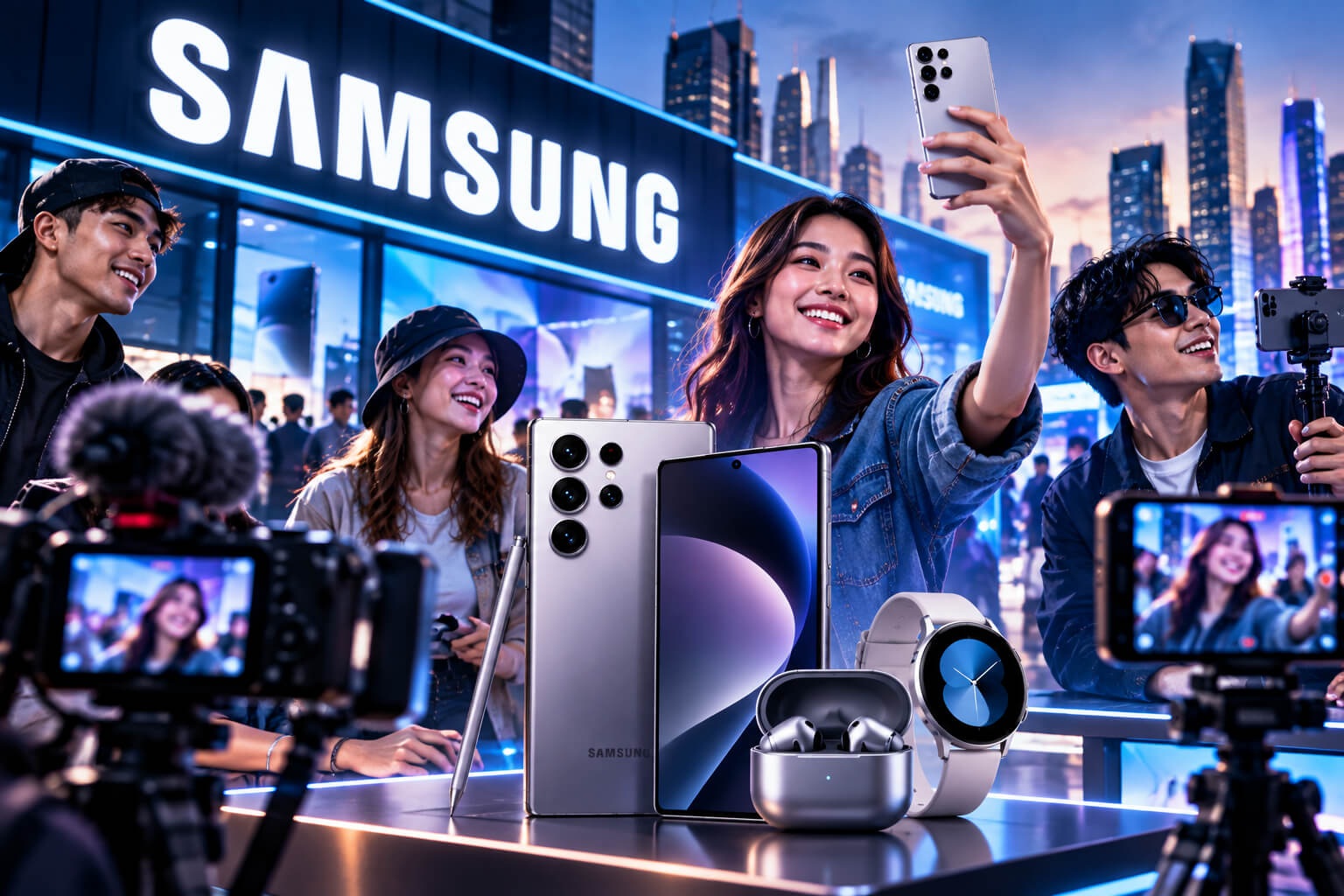
Samsung Electronics is putting creators much closer to the center of its marketing strategy, using social content, gaming, lifestyle experiences and major technology events to build stronger relationships with younger consumers.
The shift is visible in Galaxy Crew 2026, Samsung’s official creator program featuring 70 creators across 11 fields, including sports, fashion, gaming, travel, photography, beauty, entertainment and video production.
Rather than relying almost entirely on polished product campaigns, Samsung is giving creators Galaxy devices and asking them to show how the technology fits into everyday life. Galaxy AI is part of that story, but the content is designed to feel closer to what audiences already watch on social platforms.
It is a different kind of product marketing. Less demonstration. More participation.
Galaxy Crew Moves From Pilot Program to a Bigger Creator Network
Samsung tested the Galaxy Crew concept with around 20 participants in 2024 before expanding it to roughly 60 creators in 2025. The company has now formalized the program for 2026 with 70 creators working across 11 content categories.
The numbers from the previous pilot give Samsung a reason to keep going. Galaxy Crew creators produced roughly 4,000 pieces of content in 2025, generating around 90 million cumulative views and 110,000 comments. Their combined follower counts also grew by more than 160,000 during the program.
Samsung provides participating creators with access to its latest Galaxy mobile devices, invitations to product events and support for content creation. The idea is not simply to place a phone in an influencer’s hands. Creators are expected to show Galaxy products and AI features as part of their normal routines.
That distinction matters.
For younger audiences who spend much of their time inside creator-led feeds, a relatable video can introduce a feature without looking like the traditional product pitch consumers have learned to scroll past.
Samsung Takes Its Creator Strategy to IFA 2026
The strategy has also moved beyond social feeds and into major technology events.
Samsung became the official main sponsor of the IFA Creator Hub for IFA 2026 in Berlin. The space gave creators, influencers and streamers access to production facilities including streaming studios, podcast areas and dedicated spaces for creating content. IFA also programmed panels and sessions around the creator economy.
That puts creators in a different position at a trade show. They are not simply visitors covering a product launch after the fact. They become part of the infrastructure through which the event reaches audiences outside the venue.
IFA itself has been leaning further into this model, describing its Creator Hub as a meeting point between creators, brands, platforms and technology companies. Topics at its Creator Stage included AI-powered workflows, new social formats and creator business models.
Samsung, meanwhile, separated some of its trade and B2B activity from the creator-facing experience. Its specialist trade, media and business presence moved into central Berlin at Humboldt Carré, creating a clearer divide between consumer storytelling and commercial conversations.
Gaming Gives Samsung Another Route Into Creator Culture
Creators are only one part of Samsung’s effort to stay close to younger digital communities. Gaming has become another.
The company turned its #PlayGalaxy Cup into a full-season competition in 2026. Regional qualifiers covered five regions and involved 32 teams from 17 countries before 10 teams advanced to the World Final at Gamescom in Cologne.
Streamer Ludwig hosted the World Final, which Samsung livestreamed globally on YouTube. According to the company, the final attracted 12.1 million views. Players competed using the Galaxy S26 Ultra, effectively placing the device inside entertainment content rather than keeping it confined to a conventional advertisement.
It is an increasingly familiar creator-marketing playbook: build something audiences actually want to watch, then let the product exist inside the experience.
Younger Consumers Are Starting to See Samsung Differently
There are signs that Samsung’s broader effort to reconnect with younger consumers may be affecting brand perception.
A 2026 survey of 500 South Korean college students conducted through Binu Labs’ Everytime platform found that 62% identified Samsung as an innovative company, compared with 51% for Apple. Samsung’s score for being perceived as “stagnant” also fell from 40% in the previous year to 21%.
Those results cannot be attributed to creator marketing alone. Samsung’s devices, AI push, semiconductor business, product launches and broader cultural visibility all contribute to how consumers see the company.
Still, creators give Samsung something conventional advertising struggles to manufacture: repeated appearances inside the communities, hobbies and conversations its younger customers already follow.
That is particularly useful when the goal goes beyond selling the next smartphone.
Creator Marketing Becomes a Long-Term Brand Play
Samsung’s approach points toward a broader change in how large technology brands may use creators.
Influencer marketing was once heavily campaign-based. A creator received a product, produced sponsored content and moved on. Samsung’s Galaxy Crew model looks more continuous. Creators work with the products over an extended period, attend events and build content around everyday use.
For creators, that can mean deeper brand relationships rather than isolated sponsored posts. For Samsung, it creates a steady flow of content coming from different niches and personalities.
Fitness audiences see one version of Galaxy. Gamers see another. Fashion, travel, photography and beauty communities get their own interpretations.
The product stays the same. The storytelling does not.
Samsung Is Building Community Around the Product
Samsung still sells hardware, and product performance remains important. But its creator strategy suggests the company increasingly sees attention, participation and community as part of the product-marketing equation.
Galaxy Crew puts creators into everyday storytelling. The IFA Creator Hub brings them directly into one of the technology industry’s major events. #PlayGalaxy Cup turns gaming communities and livestream audiences into another point of contact.
Taken together, these initiatives show a company experimenting with something bigger than influencer promotion.
Samsung is trying to turn creators into a bridge between its technology and the culture surrounding it.
For the creator economy, that may be the more interesting part of the story.
Sources
BigGo Finance — Samsung Electronics Builds Fandom Through Creator Marketing While Pursuing B2B Results
https://finance.biggo.com/news/50e3edd1-b7f1-41ff-9385-0b2de9ed407b
Digital Today — Samsung Electronics Selects 70 Galaxy Content Creators for Galaxy Crew 2026
https://www.digitaltoday.co.kr/en/view/1030/samsung-electronics-selects-70-galaxy-content-creators-for-galaxy-crew-2026
IFA Berlin — IFA 2026 Places Greater Focus on the Creator Economy
https://www.ifa-berlin.com/press-releases/ifa2026-creator-economy
Samsung Global Newsroom — Samsung Hosts #PlayGalaxy Cup World Final at Gamescom 2026
https://news.samsung.com/global/samsung-hosts-playgalaxy-cup-world-final-at-gamescom-2026
Seoul Economic Daily — Samsung Beats Apple as Most Innovative Company Among Gen Z Students
https://en.sedaily.com/finance/2026/02/09/samsung-beats-apple-as-most-innovative-company-among-gen-z
