

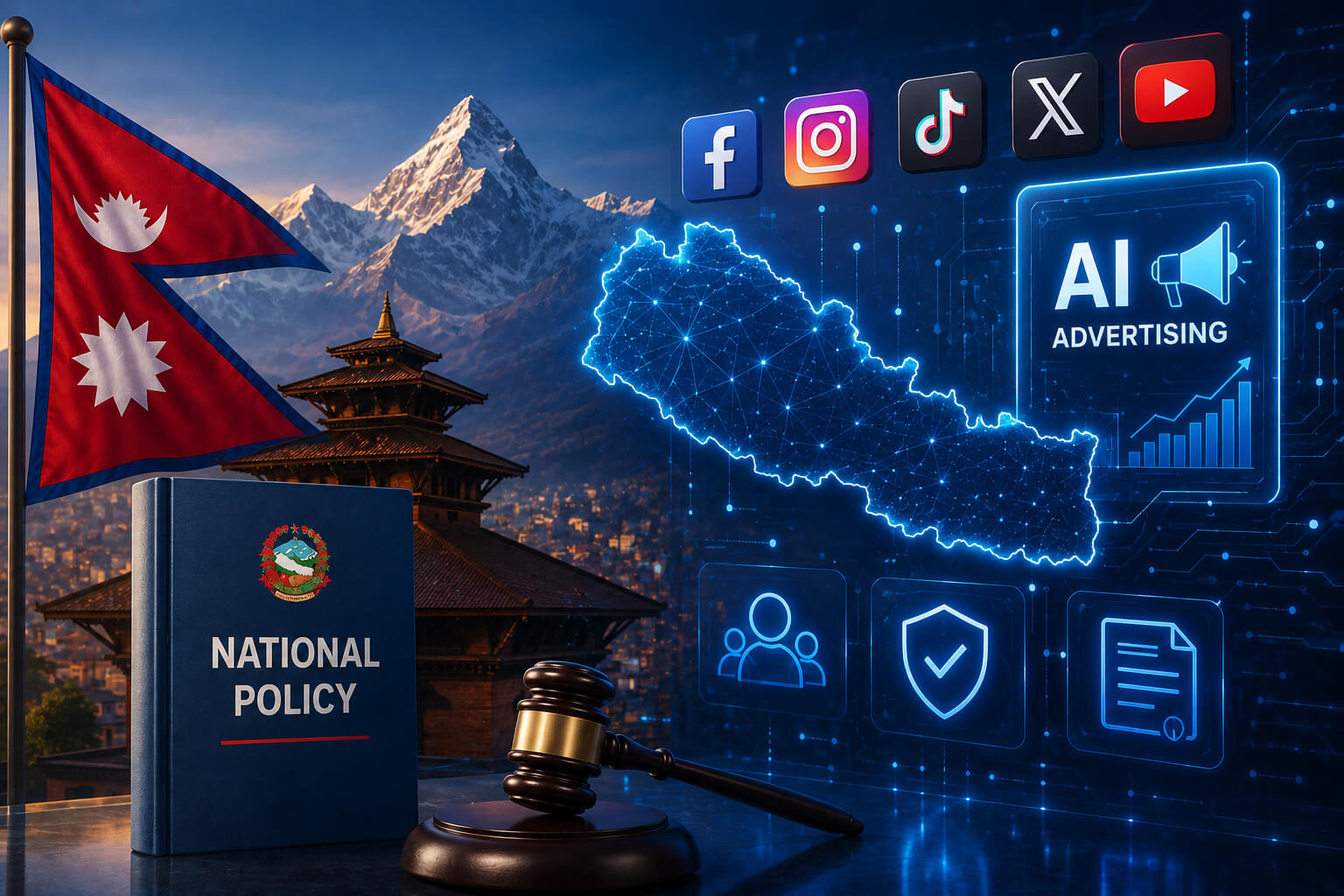
Nepal is no longer treating social media advertising like a side activity happening somewhere outside the formal media economy. Recent changes to the Nepal social media advertising policy highlight this shift.
The government has introduced the National Advertising Policy 2026, a new framework that brings digital platforms, influencer marketing, sponsored content, AI-generated advertisements, and deepfake content under regulatory oversight.
It is a big shift for Nepal’s advertising industry. For years, digital ads have grown quickly while regulation struggled to keep pace. Brands moved to Facebook, TikTok, YouTube, Instagram, and influencer-led campaigns. Agencies followed. Creators became part of the marketing machine. But the rules? They were still catching up.
Now the government wants that gap closed.
Social Media Ads Are Now Part of the Formal Advertising System
Under the new policy, advertising carried out through social media and digital platforms will fall under official regulation. That includes sponsored content, influencer promotions, and digital campaigns that may have previously existed in a grey area.
The policy makes one point very clear: paid promotion should not pretend to be ordinary content.
Sponsored posts and influencer marketing campaigns will need clear self-declaration. In simple terms, if content is paid for, promoted, or commercially influenced, audiences should be able to know that.
That matters because influencer marketing has become one of the fastest-growing parts of the advertising world. A product recommendation from a creator can look casual. A lifestyle video can quietly become an ad. A review can be shaped by a brand deal. Nepal’s new policy is trying to draw a line between genuine content and paid promotion.
Not everyone will love that. But audiences probably should.
AI-Generated Ads and Deepfakes Face New Scrutiny
The policy also brings AI-generated advertising and deepfake content into the regulatory frame.
That part feels especially timely. AI tools are making it easier to create realistic images, videos, voices, and endorsements. A fake celebrity promotion can be produced faster than many regulators can respond. A brand can create synthetic content that looks polished, persuasive, and believable. Sometimes too believable.
Nepal’s policy signals that AI advertising will not be allowed to grow without oversight.
This does not mean AI in advertising is being banned. The policy also encourages the use of modern technology in the advertising sector. The issue is not AI itself. The issue is misuse, deception, and identity abuse.
For creators, public figures, and consumers, that distinction matters. AI can help agencies produce faster campaigns. It can also be used to copy someone’s face, voice, or reputation without consent.
That is where regulation starts to become less optional.
Implementation May Be the Hard Part
The policy sounds ambitious. The harder question is whether Nepal can enforce it properly.
Advertising professionals have already pointed out that rules alone are not enough. Monitoring digital ads across platforms is difficult even for much larger markets. Social media content moves quickly. Sponsored posts can disappear. AI-generated content can spread before regulators even see it.
The Ministry of Communication and Information Technology will have a key role in regulating digital advertising, with support from the Office of the Prime Minister and Council of Ministers and the Advertising Board.
That setup gives the policy a formal structure. Still, structure is not the same as execution.
To make this work, regulators will need digital tools, trained teams, clear reporting systems, and enough authority to act when rules are broken. Otherwise, the policy risks becoming a nice document that looks serious but does little in practice.
Nepal is not alone here. Governments everywhere are trying to figure out how to regulate AI ads, influencer marketing, deepfakes, and platform-driven promotion without crushing digital creativity.
There is no clean template yet.
False and Misleading Ads Are Also in the Crosshairs
The policy also targets false, misleading, and legally prohibited advertisements that could harm consumers.
That includes ads that make deceptive claims, confuse audiences, or promote products and services in ways that violate the law. The policy includes provisions for compensation when consumers suffer losses because of false or misleading advertising.
This is one of the more practical parts of the framework.
People do not always think of advertising regulation as consumer protection, but it is. A misleading health claim, a fake investment promotion, a scam product, or a manipulated endorsement can cause real damage.
The rise of social media has made that problem harder to control. A bad ad does not need a billboard anymore. It only needs a boost button, a creator partnership, or a convincing video.
Nepal Wants Clearer Separation Between News and Advertising
Another important part of the policy focuses on the blurred line between journalism and promotion.
The government wants to discourage the practice of presenting advertisements as news, or allowing news coverage to be shaped by advertising arrangements. That is a sensitive issue, but also a necessary one.
When audiences cannot tell whether they are reading news, sponsored content, or brand messaging, trust gets damaged. Media outlets lose credibility. Advertisers get short-term visibility but long-term suspicion. Readers are left guessing.
The policy is trying to bring that separation back into focus.
Traditional Media and Digital Platforms Will Be Balanced
Nepal’s government also plans to determine the ratio of advertising between traditional and digital platforms.
That detail could become important for media companies. Traditional outlets have watched ad spending shift toward social media platforms, often without the same tax, compliance, or editorial responsibilities. Digital platforms, meanwhile, have become essential for businesses trying to reach younger and mobile-first audiences.
Balancing those two worlds will not be simple.
Too much control could slow digital growth. Too little regulation could leave traditional media and consumers exposed. The policy appears to be looking for a middle lane, though the actual impact will depend on how future rules are written.
Startups and Small Businesses Get a Place in the Policy
The policy also includes support for startups and small businesses, allowing them to spend a fixed amount on social media and digital advertising.
That part matters because digital ads are often the most affordable way for smaller businesses to reach customers. A small shop may not be able to buy television, radio, or newspaper space. But it can run a targeted social media campaign.
Regulation should not make digital advertising impossible for small players. If handled carefully, the policy could give smaller businesses more confidence to advertise online while still protecting consumers from bad actors.
A Dedicated Advertising Fund Is Coming
Nepal also plans to establish a dedicated advertising fund under existing law.
The fund will be financed through government grants, fees, contributions, donor support, and revenue generated from advertising transactions. Supporters say the fund could help finance monitoring and strengthen the advertising system.
Advertisers, however, are already asking for clarity.
That concern is fair. If the fund creates extra costs for agencies or brands, those costs may eventually be passed on to consumers. If it is structured poorly, it could discourage advertising activity instead of improving the market.
The idea may be useful. The design will decide whether it works.
Why This Policy Matters Beyond Nepal
Nepal’s move reflects a larger global problem.
Social media advertising has become too powerful to ignore. AI-generated content is moving too fast to leave completely unregulated. Influencer marketing is now a serious advertising channel, not just a casual creator economy trend.
Governments are trying to catch up with a market that changed before the paperwork did.
Nepal’s National Advertising Policy 2026 is part of that catch-up. It brings digital advertising, AI-generated campaigns, deepfakes, creators, platforms, agencies, and consumers into the same conversation.
The policy will not solve everything overnight. It may take years before the system is fully implemented. Enforcement will be difficult. Monitoring will be messy. Some parts may need revision once real-world challenges appear.
But the direction is clear.
Nepal wants social media and AI advertising to operate with more transparency, accountability, and consumer protection. For brands, influencers, agencies, and platforms, the message is simple: digital advertising is no longer outside the rulebook.
