
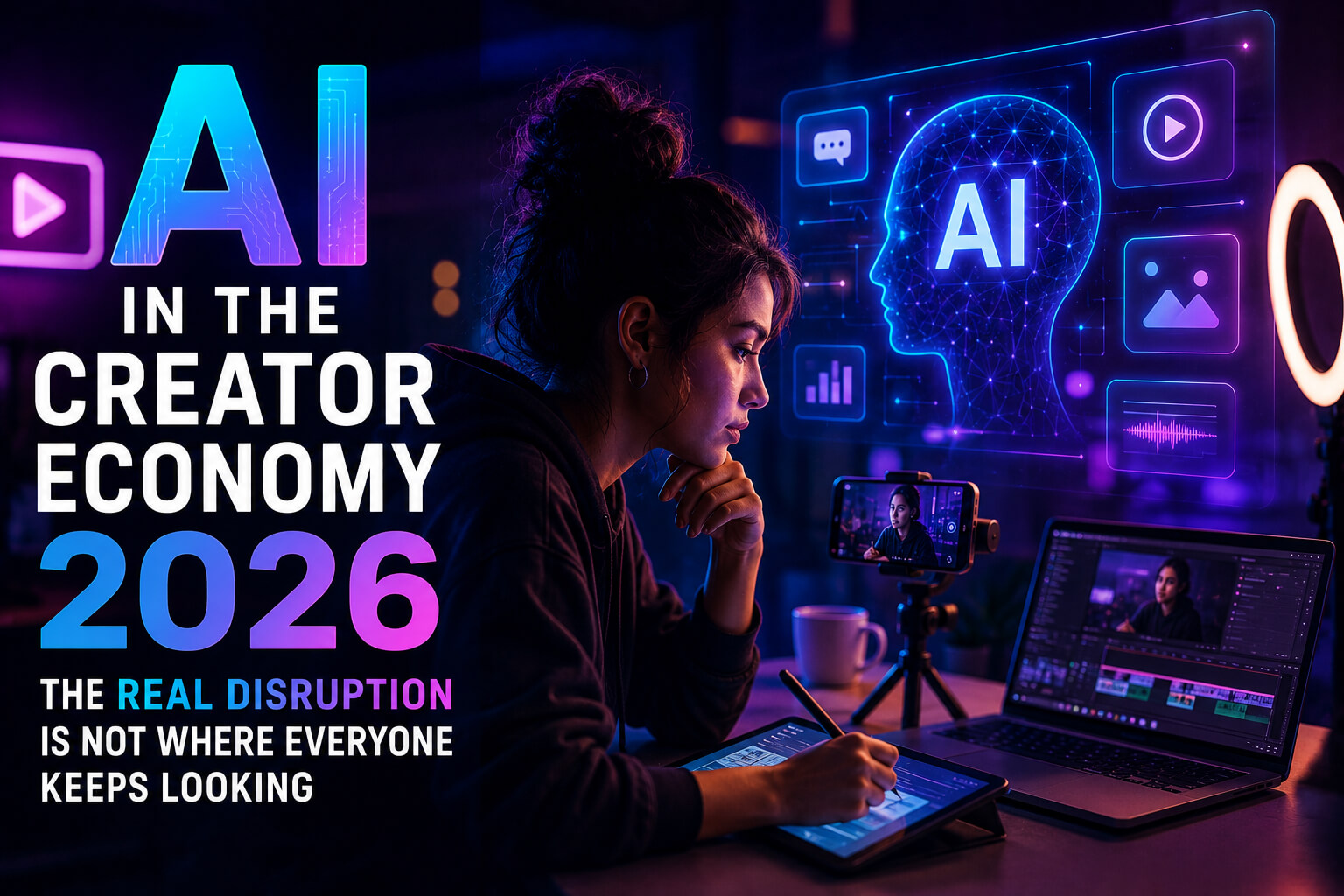
The creator economy keeps asking the same nervous question every few weeks: will AI replace creators?
It usually starts with a headline. An AI influencer lands a brand deal. A platform shows off a tool that can generate fake user-generated content at scale. Someone posts a thread about creators being finished. Then the industry calms itself down, at least until the next round.
But that may be the wrong question.
In 2026, AI is not mainly coming for the creator on camera. The stronger pressure is building around everything that happens before and after the creator makes the post. The discovery work. The spreadsheets. The contract chasing. The reporting decks. The long email chains. The middle layer of influencer marketing that brands have been paying for, often without seeing exactly what each fee actually does.
Creators Still Hold the Hardest Thing to Copy
The creator’s biggest advantage is still the audience relationship.
A machine can generate a face. It can produce scripts, images, captions, product shots, and campaign variations. It can imitate parts of the content process. What it cannot easily recreate is trust built over months or years between a real creator and a real audience.
That matters. A creator is not just a content unit. A creator carries taste, timing, personality, community memory, and the messy human context that makes audiences care.
This is why AI influencers still feel more like a headline category than a full replacement market. They attract attention. They create debate. They may even work for some campaigns. But they do not automatically replace the person whose followers already listen, comment, buy, and come back.
The safer bet is not that creators disappear. It is that creators with strong audience relationships become even more valuable.
The Expensive Middle Is Under Pressure
The creator economy has a lot of invisible labor.
Before a sponsored post goes live, someone has to find the right creator, check audience quality, review brand safety, negotiate fees, prepare contracts, send briefs, handle revisions, manage usage rights, coordinate paid boosting, and report performance after the campaign ends.
Most of that work happens behind the scenes. Audiences never see it. Brands still pay for it.
That is where AI is starting to bite.
For years, this “intermediary tax” was accepted as part of influencer marketing. Agencies charged fees. Platforms took cuts. Management firms added markups. The system worked because much of the process was manual and time-consuming.
Now AI tools are attacking the slowest parts of that chain. Creator discovery can be automated. Vetting can be accelerated. Campaign reports can be generated from live data. Matching brands with creators can happen faster than traditional agency workflows that once took weeks or months.
And once software makes the process cheaper, brands eventually ask why the old pricing still looks so expensive.
AI Is Turning Creator Marketing Into a Measurable Channel
Creator marketing has often lived in a strange space between brand building and performance marketing.
Everyone knew it worked when the results were obvious. A post went viral. A product sold out. A creator made a brand feel culturally relevant. But the industry has not always been clean or consistent about measurement.
AI changes that.
More platforms are now trying to connect creator activity directly to sales, engagement, audience behavior, and campaign performance. That gives brands more confidence. It also gives finance teams more reason to inspect the money flow.
This is where the shift gets uncomfortable.
If a campaign can be measured from creator selection to final sale, then every fee in the middle can also be questioned. What did the agency add? What did the platform add? What did the management layer add? Was the cost tied to strategy, or was it just process?
That distinction matters more in 2026 than it did a few years ago.
Agencies Will Not Disappear, But Their Value Has to Change
The easy prediction would be that AI kills influencer agencies. That is too simple.
Brands will still need strategy. They will still need relationships. They will still need people who understand creators, audiences, timing, culture, negotiations, and brand risk. AI can process information quickly, but it does not automatically understand why a creator is funny, why a joke works, or why a partnership feels forced.
The agencies that survive this shift will be the ones that can explain their value clearly.
Not vague value. Real value.
Judgment. Taste. Campaign strategy. Relationship management. Crisis handling. Creative direction. Negotiation leverage. Knowing when a creator is right even if the dashboard is not screaming it yet.
The weaker position is billing heavily for tasks that software can now perform faster and cheaper. List-building, basic vetting, manual reporting, and repetitive admin work are becoming harder to defend as premium services.
That does not mean agencies are useless. It means the fee has to pay for something better than process.
Brands May Start Asking a Tougher Question
The creator economy has grown quickly, and fast-growing channels often escape deep cost scrutiny for a while.
When budgets are rising and results look good, brands do not always stop to examine every layer of spend. That changes when the channel matures. Eventually, the CFO wants to know what is working, what is waste, and what percentage of the budget actually reaches the audience.
Other parts of digital advertising have already gone through this. Programmatic advertising faced years of questions around transparency, viewability, and how much money disappeared before reaching the actual media placement. Creator marketing may be heading toward its own version of that audit.
The uncomfortable question is simple: how much of the creator marketing budget actually goes to creators and audience impact?
Once brands start asking that seriously, the middle of the market gets repriced.
The Creator Economy Is Not Becoming Less Human
The strange part is that AI may make the creator economy more focused on humans, not less.
If software can handle the repetitive work, the human parts become easier to see. Real creator relationships. Strong communities. Creative instincts. Brand trust. Cultural timing. A creator’s ability to make people feel something without sounding like a campaign brief.
That is not small.
AI may help one creator produce more content, test more formats, localize faster, or manage a larger business with fewer resources. For top creators, it becomes leverage. For brands, it becomes a way to move faster. For agencies, it becomes either a tool or a threat, depending on how much of their business depends on manual labor.
The real story of AI in the creator economy in 2026 is not that creators are being erased.
It is that the system around them is being forced to prove its price.
What Happens Next
The winners in this next phase will probably not be the loudest AI companies or the agencies pretending nothing has changed.
Creators with loyal audiences will remain valuable. Agencies with real judgment will still have a place. Platforms that make creator marketing more transparent will gain ground. Brands will push harder for proof, especially when budgets get tighter.
The weakest players are the ones stuck in the middle, charging for work that AI can now do in minutes.
That is the shift. Not dramatic enough for the usual “AI replaces everyone” headline, maybe. But far more important for how money moves through the creator economy.
The creator may be the safest part of the chain.
Everyone around the creator has more explaining to do.
