

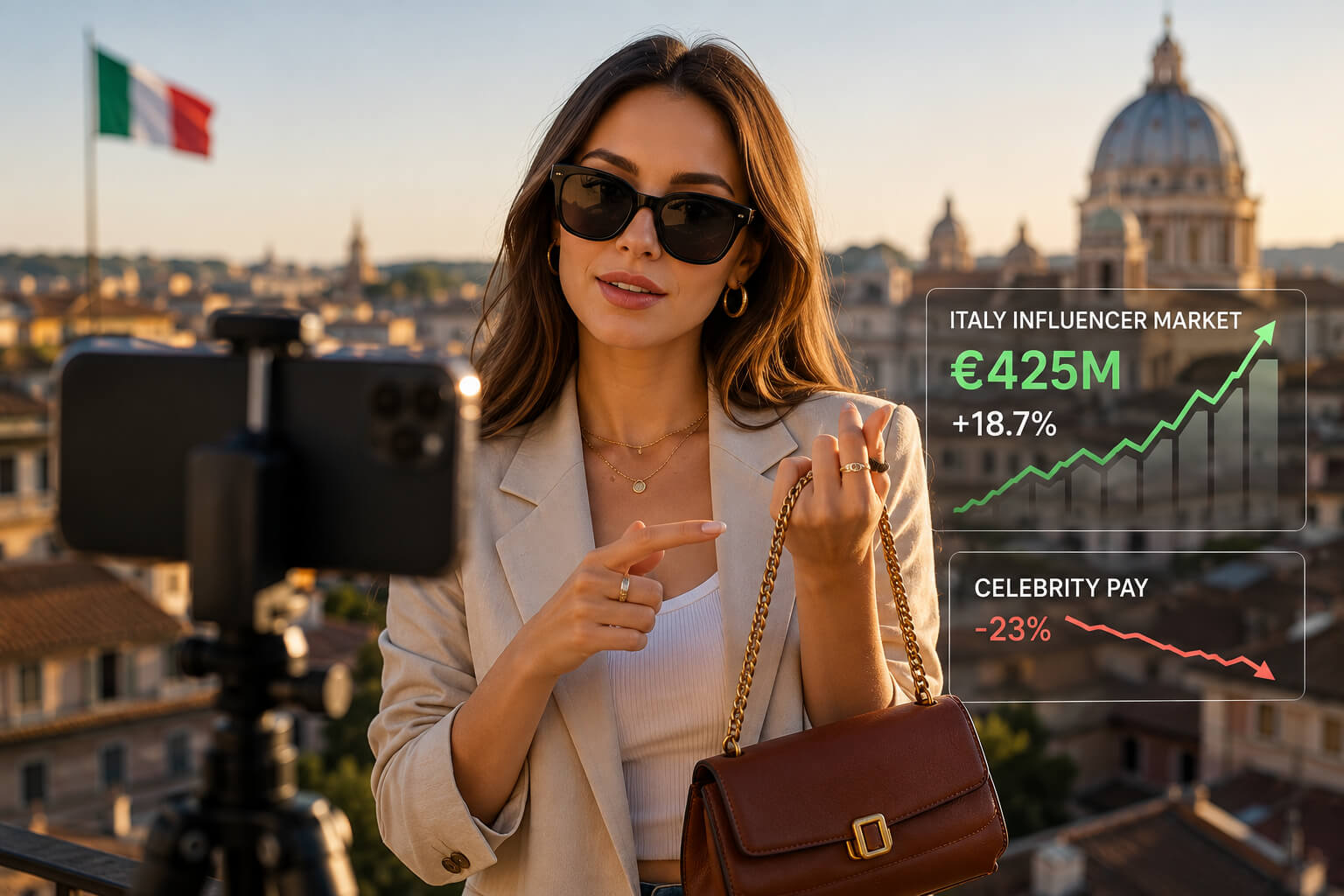
Italy’s influencer market is getting bigger, but the money is not flowing in the old direction anymore.
According to DeRev’s sixth annual “Influencer Compensation” report, influencer marketing spending in Italy is expected to reach €425 million in 2026, up from €385 million in 2025. That is a 10.4% increase, and also the fastest growth rate since 2023. On paper, it looks like a clean growth story. More money, more campaigns, more creator spending.
But underneath that headline number, something more interesting is happening. The big celebrity influencer era is starting to look less untouchable. Celebrity creators are seeing pay fall for the third straight year across every major platform tracked by DeRev, while mid-tier and macro creators are becoming the safer, sharper bet for brands.
Celebrity Influencers Are Losing Pricing Power
For years, celebrity influencers were treated like the premium buy. Huge audience, instant visibility, easy headline value. Brands liked the scale. Agencies liked the simplicity. Everyone could point to the follower count and pretend it explained the budget.
That logic is not holding as strongly now.
DeRev defines celebrity influencers as creators with more than 3 million followers on Facebook, Instagram, or TikTok, and more than 1 million subscribers on YouTube. In 2026, their per-post compensation dropped on every tracked platform: 18.8% on Facebook, 9.5% on Instagram, 8.6% on TikTok, and 2.4% on YouTube. That marks the third consecutive year of declines across all four platforms.
The issue is not only price. Audience growth is weakening too. DeRev found that 63.2% of celebrity accounts lost Instagram followers over the past year, while only 36.8% grew. That is a very different picture from mid-tier and macro creators, where audience growth remains much stronger.
Brands Are Getting More Careful With Fame
This is where the market feels less impressed by fame alone.
Big creators still matter, of course. Nobody is pretending reach has no value. But brands are becoming more cautious about ultra-general audiences, unclear returns, and reputation risk. A celebrity partnership can give a campaign instant attention, but it can also turn expensive very quickly when trust gets damaged.
DeRev CEO Roberto Esposito pointed to the fallout from Chiara Ferragni’s “Pandoro Gate” scandal as an accelerant rather than the original cause of the shift. The larger point is simple: when a high-profile creator loses credibility, the damage can travel straight into the brand partnership. For marketers, that risk is harder to ignore now.
Mid-Tier and Macro Creators Are Having the Better Year
The winners in Italy’s influencer market are not the smallest creators or the biggest names. The strongest movement is sitting in the middle.
Mid-tier creators, defined by DeRev as those with around 50,000 to 300,000 followers on Instagram and TikTok, saw pay rise 9.2% on Instagram, 7.1% on TikTok, and 2.9% on YouTube long-form video. Macro creators, with roughly 300,000 to 1 million followers, also posted gains: 7.1% on Instagram, 7.6% on TikTok, and 5% on YouTube. They were the only two tiers to increase across Instagram, TikTok, and YouTube.
This makes sense. Mid-tier and macro creators often have enough scale to matter, but not so much distance that the audience feels cold. They can still drive engagement, niche trust, and campaign relevance. That combination is becoming more valuable than broad visibility alone.
Engagement Is Doing the Talking
The numbers make the shift easier to understand. DeRev reported that mid-tier posts carry an engagement rate of 4.56%, compared with 1.61% for celebrity content. That is not a small difference. It changes how brands think about value.
A celebrity creator may still command a much higher fee, especially on platforms like YouTube, where a single celebrity video can reach up to €58,000. But a macro creator’s TikTok post may cost up to €5,400, giving brands a different kind of calculation. Less glamour, maybe. More measurable performance.
That is the uncomfortable part for celebrity influencers. The market is not saying they are irrelevant. It is saying they need to prove more than visibility.
Instagram Still Leads, TikTok Stabilizes, YouTube Holds Premium Value
Platform behavior is also changing.
Instagram remains the leading platform for influencer marketing in Italy, with pay rising across every tier below celebrity. Nano creator rates stayed flat, while micro, mid-tier, macro, and mega creators all posted increases. Celebrity pay, however, fell by 9.5% on the platform, and celebrity posting volume dropped as well.
TikTok looks more stable after two harder years. Earnings on the platform were down 19% in 2024 and 2% in 2025, but the decline narrowed to just 0.33% in 2026. Micro, mid-tier, and macro creators saw gains, while celebrity pay continued to fall.
YouTube is still the premium platform in terms of per-post value. Shorts dominate content volume, but campaign spending remains concentrated in long-form video. DeRev also added Shorts as a standalone format in its price list for the first time, valuing Shorts at roughly one-third of a standard YouTube video rate.
Facebook Is Becoming More of a Reposting Channel
Facebook’s place in influencer marketing looks weaker.
DeRev described Facebook as increasingly marginal, with the platform now used more for redistributing content made elsewhere than for native influencer campaigns. Posting volume rose sharply among mid-tier and macro creators, but much of that came from reposts and lower-effort content, including some AI-assisted material with little commercial value.
Pay fell across almost every Facebook creator tier, including micro, mid-tier, macro, mega, and celebrity influencers. For brands, Facebook may still have a role in distribution, but it is no longer where the main creator marketing energy seems to be.
TikTok Has a Disclosure Problem
One of the more sensitive findings in the report is TikTok’s sponsored content disclosure gap.
DeRev found that only 0.78% of TikTok’s most-engaged posts in Italy carried a sponsored content disclosure. That compares with 4.46% on Instagram and 29% on YouTube long-form video. The gap could bring more scrutiny as Italy’s AGCOM code and ATECO classification for influencers are now in force, putting more responsibility on brands to ensure campaigns follow disclosure rules.
This is not just a compliance footnote. As influencer marketing gets bigger, regulators are paying closer attention to how paid content is labeled. And when disclosure is weak, trust becomes the next problem.
Fashion and Beauty Still Own the Biggest Share
In terms of spending categories, Fashion & Beauty remains the biggest area for influencer marketing investment in Italy, accounting for 27% of spending. Food & Beverage follows at 18%, while Gaming & Tech and Travel & Lifestyle each hold 13.5%. Sports & Leisure rose to 9%, and Business & Finance increased slightly to 3%.
That last category may be small, but it matters. Business and finance creators are harder to find, and the reputational stakes are higher. That scarcity can push rates up, especially when brands need creators who can speak with authority instead of just visibility.
The Italian Influencer Market Is Maturing
Italy’s influencer market is not slowing down. The projected jump to €425 million proves that brands are still investing heavily in creator-led campaigns. But the market is becoming less sentimental about fame.
Follower count is no longer enough. Celebrity status is no longer automatic pricing power. Brands want creators who can hold attention, drive engagement, stay credible, and fit the campaign without dragging unnecessary risk into the deal.
That is why mid-tier and macro creators are gaining ground. They sit in a useful middle space: big enough to scale, focused enough to feel believable, and often more efficient than celebrity partnerships.
The creator economy in Italy is growing, yes. But it is also getting pickier. And that may be the more important story.
