

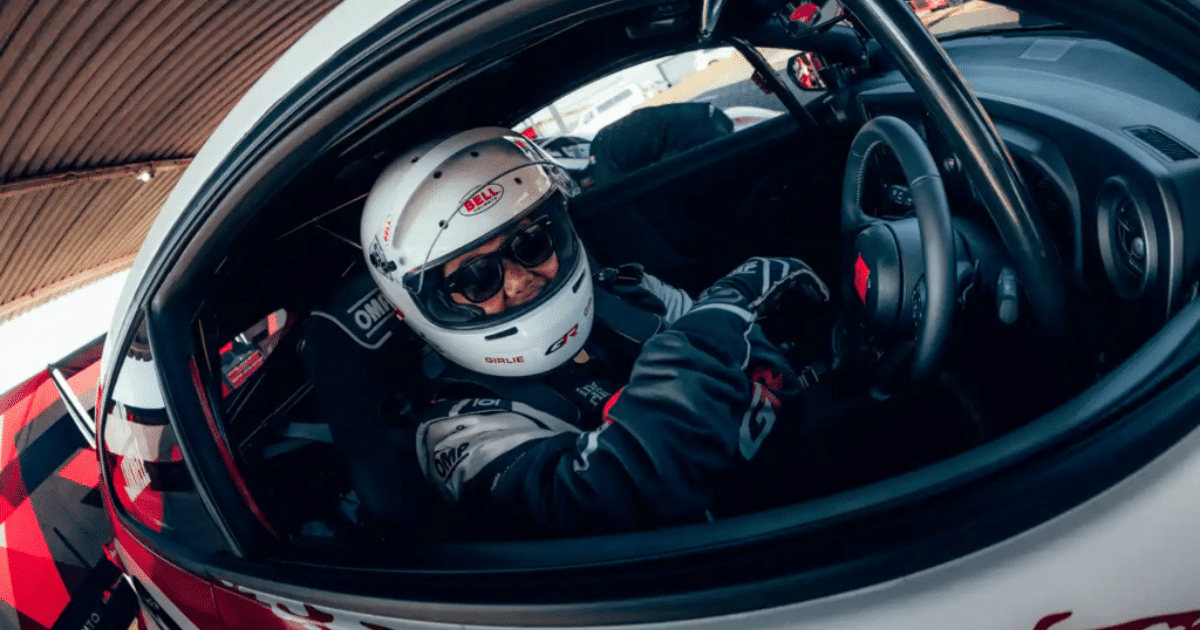
Girlie Lukhele did not enter motorsport with a polished racing résumé, a major sponsor or an expensive production team.
She started with a borrowed Xbox, a sim-racing wheel and videos showing what she still did not know.
That detail matters.
Many creators build their platforms by presenting themselves as experts. Lukhele took almost the opposite route. She filmed the awkward attempts, missed techniques and small improvements. Her followers watched her struggle with heel-toe shifting, left-foot braking and handbrake control.
Then they started helping.
What began as casual content eventually pushed the South African creator out of legal practice and into an emerging career that now combines TikTok, brand partnerships, sim racing and competition on actual tracks.
Girlie Lukhele Built an Audience by Showing the Learning Process
Lukhele’s rise did not begin with a viral victory or a perfectly edited motorsport video.
In 2023, a friend encouraged her to buy a sim-racing wheel after seeing another female creator racing online. Lukhele borrowed an Xbox console and started posting without much of a plan.
The early videos felt rough because they were rough. She was still learning how to control the car, use different racing techniques and understand the equipment in front of her.
Instead of hiding that inexperience, she left it in the content.
Her comment section soon became part coaching area, part community gathering place. Experienced sim racers offered advice while other beginners watched someone make the same mistakes they were probably making at home.
That interaction created something a polished highlight reel could not. Followers became invested in the progress.
They were not simply watching Lukhele race. They were watching her become a racer.
Audience Feedback Changed the Way Her Content Worked
One of the biggest shifts in Lukhele’s content came from an audience request that sounded almost too simple: viewers wanted to see her feet.
Screen recordings showed the game, but they did not fully show the physical technique behind the driving. Lukhele began filming her footwork while learning left-foot braking and heel-toe shifting.
Suddenly, the process became more visible.
Viewers could see when she pressed the brake, how she moved between pedals and where a mistake happened. The videos became more useful for other racers while also giving casual viewers a better sense of the skill involved.
Her followers also encouraged her to experiment beyond rally games. Although rally racing remained her main interest, the audience pushed her toward Formula 1 titles and Assetto Corsa.
She listened without allowing the audience to completely take over the channel.
That balance helped her reach more viewers while keeping the content connected to her own racing journey.
TikTok Created the Community, but Instagram Helped Build the Business
Lukhele credits TikTok with helping her grow as both a person and a creator. The platform gave her space to post frequently, experiment and build a community around learning in public.
Her TikTok audience has since grown beyond 120,000 followers.
Instagram plays a different role.
According to Lukhele, TikTok helped build her following, while Instagram became more important for business opportunities and partnerships. That split reflects a reality many creators eventually discover: the platform generating the most attention is not always the one generating the most commercial activity.
TikTok made the story easy to discover. Instagram gave brands a cleaner place to evaluate her work, audience and professional identity.
YouTube remains less developed, but that may offer room for longer videos around race preparation, equipment, behind-the-scenes footage and the transition from simulation to real competition.
For now, Lukhele appears focused on documenting what is directly in front of her rather than forcing every platform into the same content strategy.
Content Creation Gave Lukhele a Route Out of Law
Before motorsport became a serious career path, Lukhele worked toward a law degree and later practiced as a candidate attorney.
The change did not happen overnight.
She filmed content after work while dealing with the unstable income that comes with being a growing creator. Brand opportunities appeared, but not with enough consistency to make the decision easy.
Eventually, managing both paths became unrealistic.
As her platform grew, Lukhele stepped back from law and placed more attention on content and racing. She has not ruled out returning to the legal profession someday, but motorsport currently has priority.
It is not the usual career move.
Law offers a clear professional structure. Creator work rarely does. Motorsport may be even less predictable, particularly for a newcomer attempting to fund equipment, travel, training and competition.
Still, her audience gave her something the traditional route did not: visible proof that people cared about the journey she was building.
Motorsport Content Comes With Expensive Behind-the-Scenes Costs
Sim racing may happen in a bedroom, office or small gaming setup, but it is not automatically cheap.
Wheels, pedals, seats, consoles, gaming computers and replacement parts quickly add up. Creators also need cameras, lighting and editing equipment if they want to produce content regularly.
Real-world motorsport raises those costs considerably.
Race entry fees, transport, tyres, maintenance, safety equipment and vehicle preparation can consume money faster than content generates it. Lukhele has used part of her creator income to support her rally car and continue moving from digital racing into physical competition.
Affiliate programs have become one of her more reliable income streams. She has worked with brands including Next Level Racing and EA Sports, while promotional campaigns provide larger but less predictable payments.
That unpredictability remains one of the harder parts of the creator business.
A major collaboration can arrive one month, followed by silence the next. Lukhele has also pointed to the limited availability of affiliate programs for South African creators compared with markets such as the United States and Europe.
For creators outside the largest advertising markets, building an audience is only one part of the problem. Finding repeatable ways to earn from that audience can be much harder.
Sim Racing Prepared Her for Real Competition
The transition from gaming equipment to an actual race car may sound enormous, but Lukhele says sim racing gave her a useful technical foundation.
She had already practiced braking zones, racing lines and pace notes in simulated environments. The physical experience changed once she entered a real vehicle, of course, but the concepts were familiar.
That preparation started producing results.
In May 2026, Lukhele competed in the Toyota GAZOO Racing South Africa GR Cup Hot Seat program at Zwartkops Raceway. She qualified fifth in the GR Cup Media Challenge class before finishing third in both races.
She has also competed through programs connected with Team Suzuki at the Simola Hillclimb and SHIELD Racing.
The podium finishes gave her more than another piece of content. They showed that the skills developed through simulation and public practice could transfer into credible real-world performance.
That makes her story useful for brands as well.
She is not merely promoting racing equipment from the outside. Her content, audience and competitive development exist inside the same niche.
Being a Female Creator Added Another Layer of Pressure
Motorsport still has a visible gender imbalance, and Lukhele has spoken about the pressure she places on herself to prove that she belongs.
That pressure comes from two directions.
She enters racing as a woman in a male-dominated sport, but she also enters as a creator. Traditional competitors may assume an influencer received access because of follower numbers rather than ability.
A poor performance could easily feed both assumptions.
Lukhele has responded by treating each competition as a chance to demonstrate that her platform and driving development are connected. The content may have opened doors, but she still has to perform once the helmet goes on.
Her background may have helped. She grew up enjoying activities where boys often outnumbered girls, including quad biking and gaming.
The hesitation never fully disappeared. She simply learned to move before it could stop her.
Her Weaknesses Became Part of the Creator Strategy
Lukhele’s approach works because she does not pretend that every video marks a breakthrough.
Some clips show confusion. Others show a mistake or a technique she has been avoiding. Her audience often sees the problem before it sees the solution.
That structure naturally creates a continuing story.
The next post answers a question raised by the previous one. A viewer who offered advice may return to see whether she tried it. Beginners gain permission to learn without waiting until they look professional.
There is a broader creator marketing lesson here.
Expertise can attract attention, but visible progress can build attachment. Audiences often want to participate, not just admire. Lukhele gave followers a role in the development of her skills, and that participation turned casual viewers into a community.
The mistakes did not weaken her personal brand.
They made it believable.
Gravel Rallying Is the Next Part of the Story
Lukhele is preparing to take on gravel rallying, adding another stage to a path that has already moved from gaming screens to tarmac racing.
There is no neat ending yet.
That may be the strongest part of the content.
Her audience is not arriving after the difficult work has finished. Followers are seeing the funding challenges, training, technical mistakes, podium moments and uncertainty while they happen.
Lukhele’s advice to other creators reflects that experience. Start with the equipment available. Keep showing up. Do not wait for perfect conditions, because they may never arrive.
The most meaningful results have not only come from races or brand deals. She also receives messages from people who started their own sim-racing channels after watching her content.
That is a different kind of influence.
Her platform did not simply turn attention into sponsorships. It helped turn a private interest into a career, then encouraged other people to begin building their own.
What Girlie Lukhele’s Career Shows About Modern Creators
Lukhele’s journey sits somewhere between influencer marketing, gaming, sport and personal storytelling.
She did not build a following first and attach an unrelated product later. The content became part of the training itself. Audience feedback improved her skills, brand revenue helped support her racing and real competition gave the platform more credibility.
Each part strengthened the others.
That model will not work for every creator. Motorsport is expensive, sponsorships remain unpredictable and progress can disappear quickly after one mechanical problem or poor race.
Still, the basic strategy travels well.
Creators do not always need to present the final version of themselves. Sometimes the unfinished version gives the audience more reason to stay.
Girlie Lukhele started by showing what she could not yet do.
Now she is building a career around what happened after she tried anyway.
Sources
- Net Influencer – Driving Her Own Story: How Creator Girlie Lukhele Turned Content Into a Motorsport Career
- Girlie Lukhele’s Creator Profile
- Girlie Lukhele on TikTok
- Girlie Lukhele on Instagram
- Girlie Lukhele on YouTube
