
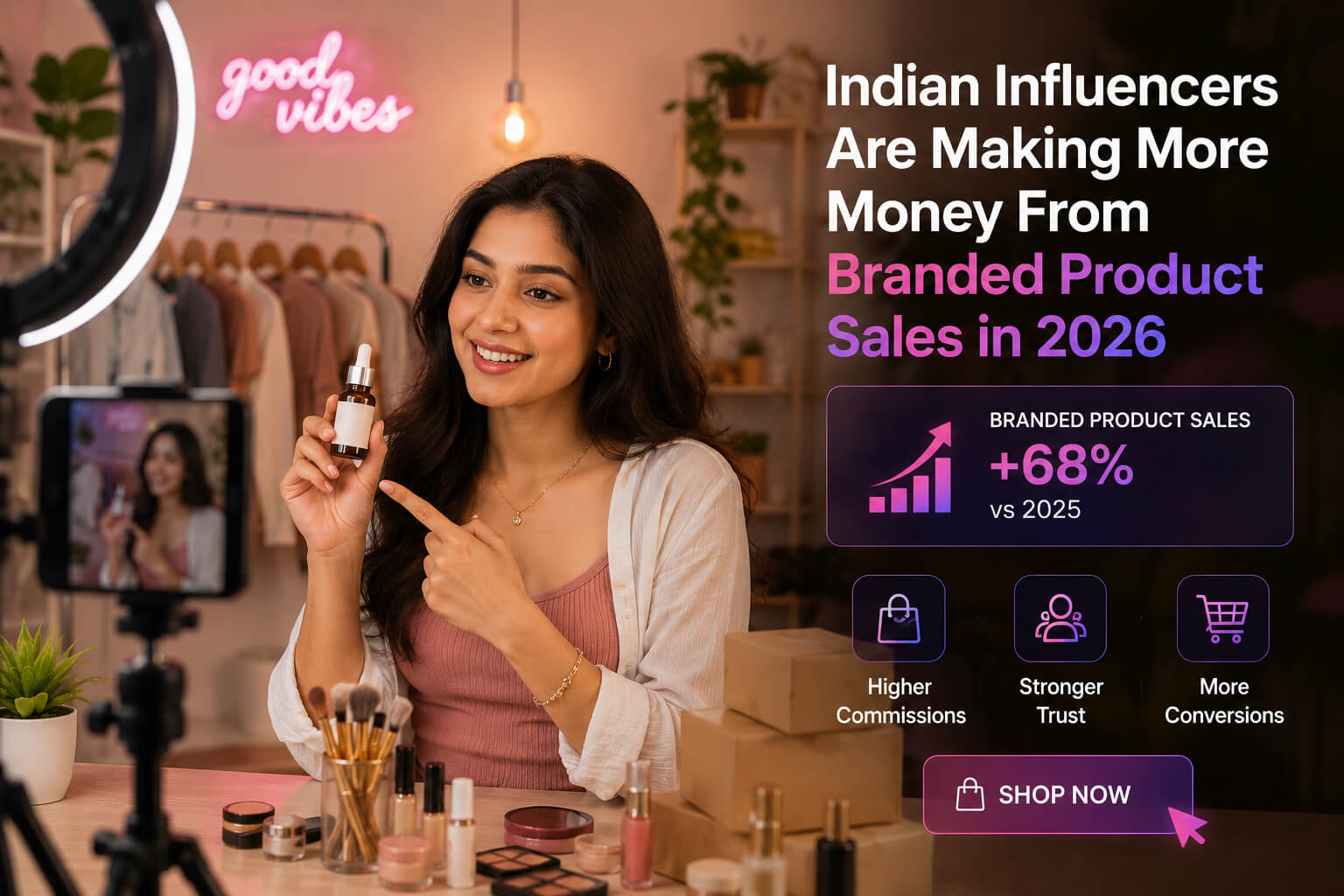
Indian influencers are not just posting brand deals anymore. They are driving Indian influencers branded product sales and actually selling.
That is the bigger shift behind new Trendweave data, which says content creators in India earned over 35% more from product sales in 2026. The creator monetisation platform analysed more than four million follower orders and found that influencer-led commerce is growing especially fast in travel, online services, and fashion.
For years, influencer income was mostly talked about in terms of sponsored posts, campaign fees, and ambassador deals. A brand pays, the creator posts, the campaign ends. Simple. Maybe too simple.
Now the money is moving closer to actual transactions.
Creator Commerce Is Becoming a Real Income Stream
India’s influencer marketing industry is already estimated to be worth between Rs 3,375 crore and Rs 5,500 crore, according to the report. But the more interesting number is not just the size of the industry. It is how creators are earning inside it.
Trendweave found that sales of goods and services through Indian influencers rose by more than 28% year-on-year in the first half of 2026. That means audiences are not only watching creator content. They are clicking, buying, booking, subscribing, and trying products based on creator recommendations.
This fits India’s mobile-first shopping behavior. Instagram shopping tools, promo codes, affiliate links, Telegram communities, live shopping formats, and direct product recommendations all make the buying path shorter. Sometimes painfully short. A viewer sees a creator use something, checks the price, taps the link, and the sale is done before the video even leaves their head.
Fashion Still Leads, But New Niches Are Catching Up
Fashion remains the biggest money-maker for Indian creators, accounting for 30% of total influencer profits from product sales. Home goods followed at 13%, while household appliances and electronics accounted for 11%. Personal care and pharmacy products made up 10%, with sports goods at 7%.
No surprise there. Fashion has always been one of the easiest categories for influencer selling because it is visual, personal, and easy to demonstrate. A creator wears the outfit, talks about the fit, shares the link, and the audience gets the idea fast.
But the fastest-growing areas tell a slightly different story.
Plane ticket earnings jumped 42%. Online services, including B2B, IT, education, and delivery-related services, rose 40%. Financial products increased 35%. Books grew 25%, while fashion still posted a strong 23% rise.
That is where the market starts to look more mature. Creators are no longer limited to beauty hauls, fashion try-ons, and gadget reviews. They are becoming discovery channels for travel, software, education, finance, entertainment, and everyday services.
Smaller Niches Are Starting to Look Smarter
There is another quiet change happening. Not every creator wants to fight inside crowded categories anymore.
Trendweave data showed that the number of fashion bloggers in India dropped by almost a third in 2026. Meanwhile, influencers promoting online services increased by 20%, books and stationery by 16%, sporting goods by 14%, and travel products by 10%.
That says a lot.
Fashion still pays, but it is packed. Everyone is styling outfits. Everyone has discount codes. Everyone is trying to stand out in a feed that already looks full. Some creators are choosing narrower spaces where the audience may be smaller, but the purchase intent is clearer.
A creator talking about travel planning, finance apps, learning tools, or sports equipment may not look as flashy as a fashion creator. But if the audience trusts them, the conversion can be stronger. Brands are noticing that too. A niche creator with the right followers can be more useful than a bigger creator with a vague audience.
Instagram Still Has the Strongest Buying Pull
Instagram appears to remain the strongest platform for creator-driven purchases in India. Trendweave said Instagram users spend an average of more than $31 per order after recommendations from favorite creators. Pinterest followed closely at $30, while Telegram users averaged $27 per order.
Facebook, X, and YouTube came in lower, with average purchases of $21.8, $18.7, and $15 respectively.
That does not mean YouTube is weak. It just plays differently. YouTube is often better for deeper explanations, reviews, tutorials, and long-term trust. Instagram, on the other hand, is built for quick discovery and fast action. See it, like it, buy it. Very little friction.
Telegram is interesting too. Its average order value suggests that private or semi-private creator communities can still move money, especially when followers feel like they are getting insider recommendations, early deals, or exclusive codes.
Creators Are Becoming Performance Marketing Partners
This is probably the part brands care about most.
Influencers are moving deeper into performance marketing, where payment is tied to results such as sales, installs, leads, or other tracked actions. That changes the relationship between creators and brands. It is no longer only about reach or impressions. It becomes about whether the creator can actually move people to do something.
Trendweave noted that creators are now mixing several income streams at once: fixed campaign fees, affiliate commissions, CPA partnerships, ambassador deals, and even their own product lines. Samrat Dutta, MD of Mitgo APAC, said this hybrid monetisation model is becoming more common among creators producing shoppable content, with influencer partners in India increasing by 15% in 2026.
That hybrid model gives creators more control. It also gives smaller creators a way in. They may not get a large brand contract immediately, but with affiliate links or CPA deals, they can start earning from actual sales even with a modest audience.
The Creator Economy Is Moving Closer to Commerce
The old influencer economy was built around attention. Who has followers? Who gets views? Who can make a product look cool?
Those things still matter. But they are not enough anymore.
The newer creator economy is being pulled toward commerce. Can the creator sell? Can they explain a product without sounding fake? Can they make a follower trust the recommendation enough to buy? Can they do it repeatedly without burning out their audience?
Trendweave predicts that sales through Indian bloggers could grow by more than 30% by the end of 2026, while creator income from those sales could rise by more than 45%, especially with major shopping periods still ahead.
That is a strong signal for brands watching India’s creator market. Influencers are not just media partners anymore. Many are becoming storefronts, sales channels, community builders, and product discovery engines all at once.
Messy? A little.
But that is exactly why it feels real.
