


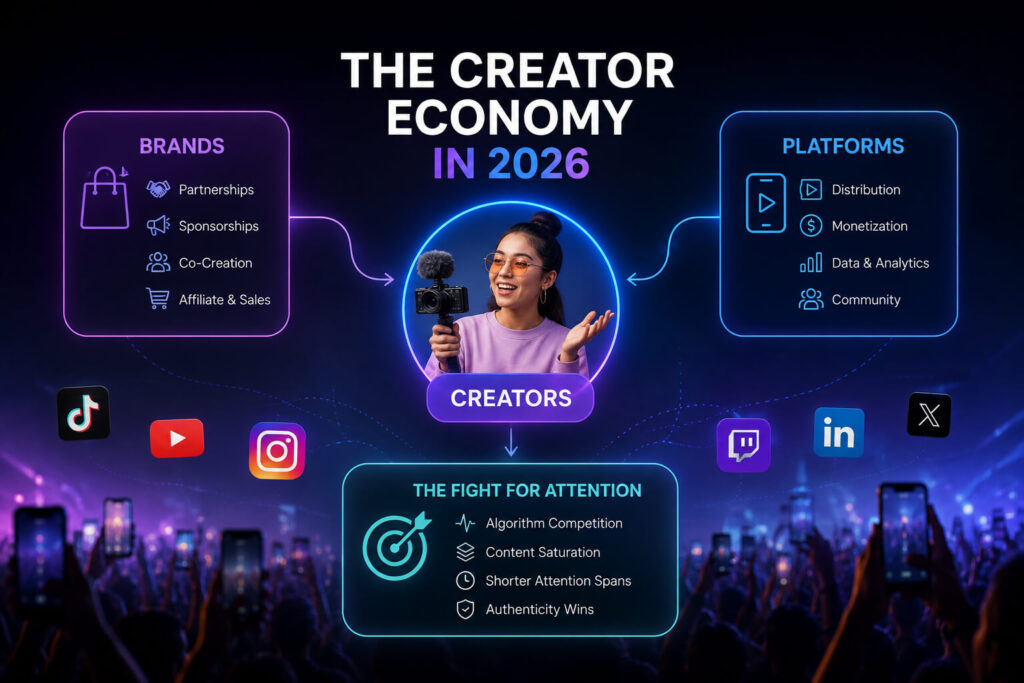
The creator economy in 2026 has become one of the most important parts of modern media, marketing, and entertainment. What started as influencers building audiences on social platforms has evolved into a complex business ecosystem involving creators, brands, agencies, platforms, advertisers, software companies, and investors.
At the center of this shift is one thing: attention.
For decades, media companies controlled attention through television networks, studios, magazines, and radio. Brands paid those media companies to reach audiences through ads. Today, that model has changed. Audiences now spend their time inside personalized feeds on platforms like YouTube, TikTok, Instagram, Twitch, and other digital spaces.
Instead of a few media giants controlling distribution, millions of creators now compete for attention every day. But this does not mean creators control the system. In many cases, platforms still decide who gets reach, which videos are shown, and how long attention lasts.
That is why understanding the creator economy in 2026 requires looking beyond follower counts. The real economy is built around content production, algorithmic reach, audience trust, and direct relationships.
Algorithms Now Reward Interest, Not Just Followers
One of the biggest changes in the creator economy is the decline of the traditional follower graph. In the past, following an account was the main way users saw content. If a creator had a large audience, they had a clear advantage.
In 2026, that advantage is no longer guaranteed.
Social platforms increasingly rely on interest-based recommendation systems. These systems show users content based on what they are likely to watch, click, like, comment on, or share. A user does not need to follow a creator to see their content. The algorithm simply needs to believe the content will keep that user engaged.
This has changed the value of followers. A creator with millions of followers can still struggle to get views, while a small creator with the right video can reach a massive audience.
For creators, this creates opportunity and instability at the same time. New creators can break through faster than before, but established creators can no longer rely only on audience size. Every post must compete again.
For brands, this changes influencer marketing strategy. Instead of paying only for big names, brands are increasingly working with many smaller creators who can produce niche, authentic, and platform-native content.
Content Volume Has Become a Core Marketing Strategy
The modern feed moves quickly. Most short-form videos have a short life span. A post may perform well for a few hours or days, but very few short-form posts continue gaining attention for weeks or months.
This creates a major challenge for brands.
To stay visible, brands need a steady flow of content. One polished campaign is no longer enough. The feed rewards repeated attempts, constant testing, and content that feels natural to specific communities.
That is why creators have become so valuable to brands. Creators can produce content quickly, understand platform culture, and speak directly to niche audiences. Instead of hiring a studio to make a small number of expensive ads, brands can work with a roster of creators to generate many videos at once.
In this model, a brand deal is not only about borrowing a creator’s popularity. It is also about buying access to a flexible content production system.
Creators help brands solve three major problems:
- They create platform-native content.
- They understand audience language and trends.
- They can produce content faster and cheaper than traditional teams.
This is one reason creator marketing has become a central part of digital advertising.
Platforms Benefit From Having More Creators, Not Fewer
Social platforms have a strong incentive to keep the creator pool large and competitive. If only a few major influencers controlled attention, those influencers would have more power over platforms. They could demand better terms, higher payouts, or more control.
But when reach is spread across millions of creators, platforms hold more control.
Interest-based algorithms help platforms achieve this. They can distribute attention to whoever creates the most engaging content at a specific moment. This means the platform does not need to depend on one celebrity, influencer, or media company.
For users, this creates a constant stream of fresh content. For platforms, it keeps engagement high. For creators, it creates a more difficult reality: reach is never fully owned.
A creator may have talent, consistency, and followers, but the platform still controls distribution. This is why many creators feel pressure to post constantly, chase trends, and adapt to algorithm changes.
The Mid-Tier Creator Is Under Pressure
The creator economy in 2026 is not affecting all creators equally. The biggest pressure is landing on mid-tier creators, especially those who rely heavily on short-form content and brand deals.
Mega-creators still attract large brand budgets because they offer fame, recognition, and cultural influence. Micro-creators and user-generated content creators are also attractive because they are affordable and can be hired at scale.
The middle is where the squeeze happens.
Mid-tier creators may have strong followings, but their reach is no longer guaranteed. If brands can get similar short-form reach from dozens of smaller creators at a lower cost, they may choose that option instead.
This does not mean mid-tier creators are finished. But it does mean they need stronger business models. Relying only on short-form views and one-off brand deals is becoming riskier.
The most durable mid-tier creators are building deeper audience relationships through long-form content, newsletters, communities, podcasts, live events, courses, memberships, and owned platforms.
Short-Form and Long-Form Content Now Serve Different Purposes
Short-form content and long-form content are both important, but they work differently.
Short-form content is powerful for discovery. It helps creators reach new people quickly. It is fast, shareable, and easy for algorithms to test across different audiences. However, short-form attention is often temporary. A viewer may enjoy a clip without remembering the creator behind it.
Long-form content works differently. Podcasts, YouTube videos, livestreams, newsletters, and other longer formats build trust over time. When audiences spend 20 minutes, one hour, or several hours with a creator, the relationship becomes stronger.
This is why many creators are using short-form content as the top of the funnel. A short clip brings in new viewers. Long-form content turns those viewers into loyal fans.
The rise of clipping has made this strategy even more important. Podcast episodes, livestreams, interviews, and long YouTube videos can be cut into multiple short clips. These clips travel across social feeds and bring attention back to the original creator.
In 2026, the smartest creators are not choosing between short-form and long-form. They are using both together.
Creator Economy Deals Are Moving Beyond Individual Influencers
Another major sign of the creator economy’s maturity is the rise of acquisitions. Large advertising groups, consulting firms, commerce platforms, and marketing technology companies are buying creator agencies, influencer platforms, and social commerce businesses.
This shows that the creator economy is no longer viewed as a side category. It is becoming core infrastructure for advertising and media.
Brands need creators. Agencies need creator networks. Commerce companies need creator-led sales. Platforms need endless content. Investors and major companies are following the money.
The biggest checks in the creator economy may not always go directly to individual creators. Increasingly, they go to the companies that manage creator relationships, measure performance, connect creators with brands, and turn influence into sales.
This means the industry is becoming more professional, but also more competitive.
The Most Valuable Asset Is a Direct Audience Relationship
The biggest lesson for creators in 2026 is simple: rented reach is not the same as owned audience.
A creator’s social reach can rise or fall depending on algorithm changes, platform policies, content trends, and audience behavior. But a direct relationship with an audience is harder for platforms to take away.
That is why creators are investing in email lists, private communities, paid memberships, websites, apps, events, and other owned channels. These spaces give creators more control over communication, monetization, and loyalty.
For creators, the feed is still useful. It remains one of the best tools for discovery. But relying only on the feed is risky.
The strongest creator businesses use social platforms to attract attention, then move loyal fans into channels they control.
What This Means for Brands
For brands, the creator economy in 2026 requires a different approach to influencer marketing.
One-off sponsored posts are no longer enough. Brands need long-term creator partnerships, recurring faces, flexible briefs, and content that feels native to each platform.
The best creator partnerships are not just ad placements. They are relationships. When audiences repeatedly see a creator connected to a brand, trust can build over time.
Brands should also think beyond reach. A creator’s value is not only measured by follower count or views. Trust, niche authority, content quality, community strength, and conversion potential all matter.
A smaller creator with a loyal audience may deliver more value than a larger creator with weak engagement.
What This Means for Creators
For creators, the message is clear: build beyond the algorithm.
Short-form content can help creators grow, but it should not be the entire business. Creators need to think like media companies, community builders, and entrepreneurs.
The most important strategies for creators in 2026 include:
- Building long-form content that develops trust
- Creating owned channels such as newsletters or communities
- Developing recurring brand partnerships
- Turning short-form attention into loyal followers
- Diversifying income beyond platform payouts
- Creating products, services, memberships, or events
- Understanding the business side of influence
The creator economy still offers major opportunities, but it rewards creators who build durable relationships rather than relying only on viral reach.
The Creator Economy in 2026 Is About Control
The creator economy in 2026 is not just about content. It is about control.
Platforms control distribution. Brands control budgets. Agencies control access to deals. Algorithms control visibility. Creators control creativity, trust, and audience relationships.
The creators who succeed long term will be the ones who understand this system and build around it. They will use platforms for discovery, but they will not depend entirely on them. They will create content for algorithms, but they will build relationships with people.
The future of the creator economy belongs to those who can turn attention into trust, and trust into a business they actually own.