


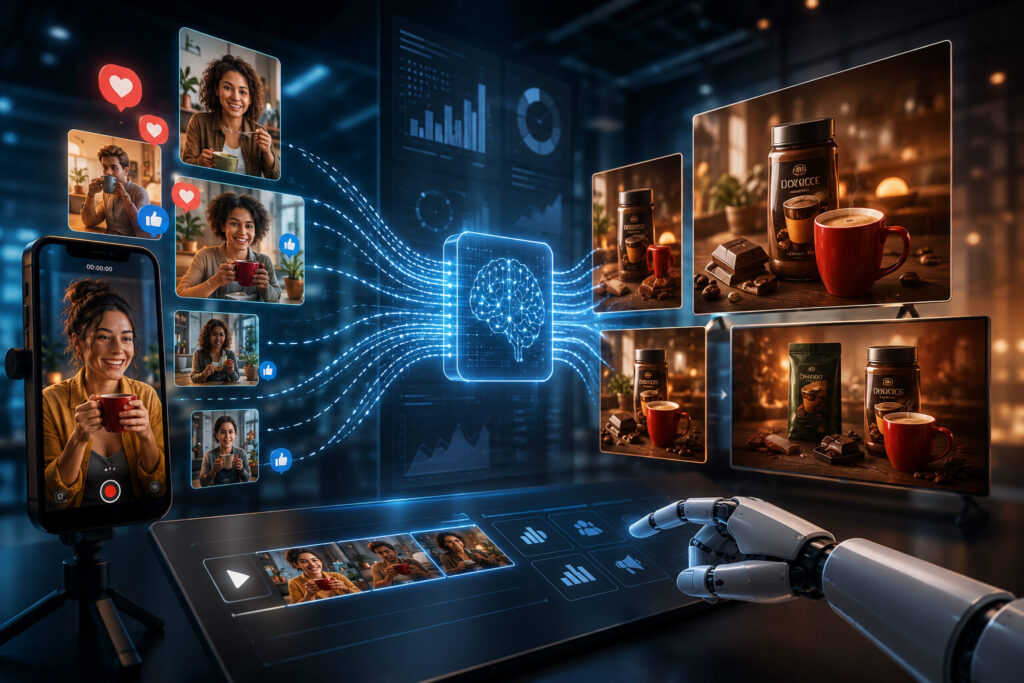
With the help of advanced creator marketing technology, Nestlé is adopting influencer content to generate high-performing, brand-safe advertising campaigns. The multinational food company is implementing tools from CreatorIQ and CreativeX to assess, score, and optimize creator content prior to any ad spend.
It reveals that brands are now moving creator marketing from experimental projects into the mainstream advertising landscape.
How Nestlé’s New AI Tool Works
To streamline creator marketing, Nestlé has connected CreatorIQ’s influencer management platform to CreativeX’s AI system via API integration. As a result, all submitted creator content is scored based on the following:
- Level of brand awareness
- Quality of storytelling
- Relevance to campaigns
- Effectiveness of creatives
Once scored, all content becomes accessible in the CreatorIQ platform, enabling campaign managers to analyze and optimize creative assets before deploying their ads.
According to Nestlé, its new workflow helps guarantee that influencers’ content is as creative and high-quality as ads produced by marketers.
Why Brands Are Increasing Investments in Creator Ads
Creator marketing has emerged as one of the most promising advertising strategies today. Industry estimates indicate that the total revenue generated by creator ads could reach $44 billion in 2026, with a majority of it coming directly from paid media budgets.
Compared to other media types, branded content created by creators is generally seen as:
- More genuine in social streams
- More engaging
- Higher-performing than regular ads
- Better suited for young generations
That’s why Nestlé and other major brands are treating creator ads not as one-time influencer partnerships but rather as a long-term investment.
The Challenge of Scaling Creator Content
When it comes to creator content, scaling becomes the major challenge for large companies.
First of all, influencer-generated content has to comply with specific requirements related to:
- Corporate branding
- Adherence to legal regulations
- Conformity with platform rules
- Alignment with global marketing guidelines
Secondly, the issue of scalability implies that a brand needs to filter out only those creator posts which would be appropriate for paid ad campaigns. By leveraging AI technologies, brands like Nestlé can mitigate any risks associated with poor branding or low-quality creatives.
Considering that the company produces thousands of products across multiple international markets, it becomes clear why it has to invest in such a solution.
Creator Economy Becomes a Part of Advertising Pipeline
Influencer marketing experts state that nowadays creator economy is no longer about partnerships with influencers.
What brands now ask is:
Which creator content is best to scale as paid media?
It’s evident that the question represents a new paradigm in the sphere of social media advertising and content creation.
AI Technology Shapes Influencer Marketing Strategies
By incorporating artificial intelligence into its influencer marketing strategies, Nestlé is following a similar path.
Today, AI tools are widely adopted in influencer marketing processes due to their ability to help companies perform various tasks, such as:
- Predicting performance of creative ads
- Checking brand safety
- Scoring creator content
- Audience segmentation and targeting
- Optimizing campaigns
For big multinational brands, AI technology can reduce costs associated with ad production, provide consistent brand messaging, and fasten launch processes.
Implications for Creators and Influencers
From a creator’s perspective, the increasing influence of artificial intelligence and algorithmic advertising implies that the future of branded content will become more and more data-oriented and focused on ad performance.
Thus, content creators who manage to produce:
- Attention-grabbing titles
- Clearly branded creatives
- Videos with a high retention rate
- Organic platform storytelling
have good chances to get their branded content distributed via paid ads.
Still, it’s expected that in the future, quality standards for influencer content might grow even further.
Conclusion
Through the example of Nestlé, it’s evident that brands are transforming influencer marketing into one of the cornerstones of modern-day advertising.
By merging authentic creator content with enterprise-level ad control, companies are discovering innovative ways to scale influencer marketing and leverage brand-safe performance-driven ads.
As AI technology continues to evolve, it’s predicted that branded creator content could become the most dominating element of the advertising landscape soon.