


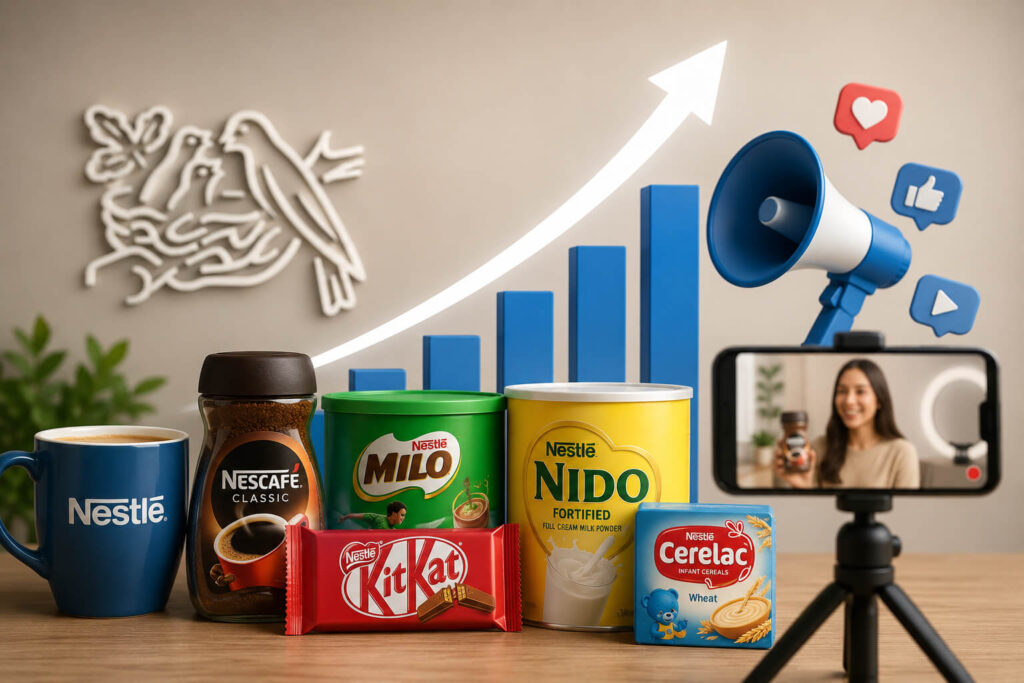
Nestlé is spending more on marketing at a time when many companies would probably reach for the red pen. The company has announced its Nestlé marketing spend 2026 is expected to increase compared to previous years. Its first-half profit fell. Coffee and cocoa remained expensive. Currency movements dragged down reported sales. The company also absorbed restructuring costs and the impact of an infant formula recall.
Still, Nestlé increased advertising and marketing investment. Advertising and marketing expenses reached 8.9% of sales during the first half of 2026, up 30 basis points from a year earlier. Gross spending increased by an even larger amount, although Nestlé said efficiency improvements softened part of that rise.
That is not a small detail buried inside an earnings report. It says quite a bit about where Nestlé believes future growth will come from. The company is trimming parts of the business, concentrating on fewer priorities and putting more money behind the brands it expects to carry the portfolio. Creator content now sits inside that wider plan, not somewhere off to the side as an experimental social media tactic.
Nestlé Keeps Investing Even as Profit Comes Under Pressure
Nestlé recorded CHF 43.1 billion in sales during the first six months of 2026. Reported sales fell 2.5%, largely because foreign exchange movements created a 6.2% negative impact. The underlying business looked healthier. Organic growth reached 3.6%, including 1.5% real internal growth and 2.1% pricing. Momentum also improved in the second quarter, when real internal growth climbed to 1.8%.
Profit told a rougher story. Underlying trading operating profit dropped 2.8% to CHF 7.1 billion, while the margin slipped to 16.4%. Net profit fell 31.4% to CHF 3.5 billion, partly because of restructuring expenses and write-downs linked to businesses being prepared for sale.
Higher coffee and cocoa costs did not help. Neither did tariffs, foreign exchange pressures or the infant formula recall. Nestlé also named increased advertising and marketing expenditure as one of the factors weighing on profit. In other words, the company knew the extra marketing money would hurt the short-term numbers. It spent it anyway.
The Marketing Increase Is About More Than Buying More Ads
Nestlé has been talking for some time about focusing investment on its strongest global and local brands. The company wants fewer scattered efforts and more backing for products, platforms and innovations that can produce meaningful growth. That sounds neat in an investor presentation. The harder part is making thousands of pieces of content work across different brands, countries, agencies, platforms and audience groups.
Nestlé has already started building the infrastructure for that problem.
Earlier in 2026, the company worked with CreatorIQ and CreativeX on an AI-powered integration that connects creator campaign management with paid-media creative analysis. Creator submissions can move from CreatorIQ into CreativeX, where the content is evaluated against Nestlé’s standards for branding, storytelling and relevance.
Campaign teams can then review the scores, request improvements and identify creator posts that may deserve paid promotion. The creator makes the content. Nestlé decides whether that content can travel further.
Creator Posts Are Moving Into the Paid Media Machine
For years, influencer marketing often operated as its own little island. A brand would hire creators, collect the posts, check the engagement and move on. The paid-media team might run a separate campaign with different assets, different measurements and sometimes a completely different creative direction.
Nestlé is trying to close that gap. Its CreatorIQ and CreativeX integration treats creator work as a possible input for larger advertising campaigns. A strong TikTok, Reel or short-form video does not have to disappear after the creator’s contracted post. It can be scored, approved and repurposed across paid social channels when the rights and campaign terms allow it.
That changes the economics of creator partnerships.
The value is no longer limited to the creator’s immediate audience or the engagement generated by one upload. A useful asset can become part of a much wider media buy. One creator video may end up supporting awareness, retargeting, product launches or market-specific campaigns.
Nestlé described creators as an essential part of how it tells brand stories globally. Its system now aims to make that content easier to evaluate and scale before advertising money begins flowing behind it.
Authenticity Still Has to Survive the Approval Process
There is an obvious tension here.
Creator content tends to work because it feels less polished than a conventional commercial. The language is familiar. The camera work may be imperfect. The creator already knows how to speak to the audience without sounding like a product brochure.
A global brand, however, cannot simply publish everything.
The logo may appear too late. The product could be shown incorrectly. A claim may create legal trouble. The creator’s story might be entertaining but barely connected to the brand.
Nestlé’s system attempts to catch those problems early. Creator assets receive automated scoring based on the company’s creative requirements, while campaign managers retain a clearer view of what should be approved, revised or promoted.
That could make creator campaigns faster and more consistent. It could also make them painfully generic when brands apply the rules too aggressively.
The technology is not the interesting part by itself. The real test is whether Nestlé can add structure without sanding away the personality that made the creator worth hiring.
Coffee and Snacks Give Nestlé Plenty of Creator-Friendly Material
Some of Nestlé’s strongest-performing categories already fit naturally into creator culture.
Coffee delivered 7.5% organic growth in the first half of 2026, helped by both pricing and real internal growth. Food and snacks grew 3.7%, while waters and premium beverages increased 5.1%.
These categories live comfortably inside routines, recipes and lifestyle content.
A coffee launch can appear in a morning vlog. Confectionery can become part of food reviews, seasonal videos or entertainment-led campaigns. Premium beverages work in hosting, dining and travel content. Petcare gives creators an entire cast of animals to work with.
Nestlé does not need to force these products into social media. They are already there.
The company’s challenge is finding creator ideas that people actually want to watch, then turning the best ones into repeatable brand assets without making every post look as though it came from the same corporate template.
Nestlé Is Simplifying the Business but Not Pulling Back From Marketing
Nestlé is also making large changes to its portfolio.
The company plans to form a 50:50 joint venture with Platinum Equity for its waters and premium beverages business. The proposed company, called Peranel, carries an enterprise value of EUR 4.9 billion and is expected to provide Nestlé with approximately CHF 2.8 billion in cash proceeds when the deal closes.
Its mainstream vitamins, minerals and supplements business and its ice cream operations have also been classified as assets held for sale. Nestlé acquired the remaining stake in smart-food brand yfood and sold Blue Bottle Coffee during the first half.
This is a company narrowing its focus, not simply shrinking.
Nestlé still expects organic growth of between 3% and 4% for the full year. Its cost-saving program has generated CHF 1.7 billion so far, with CHF 2 billion targeted for 2026.
Some of those savings are helping protect margins. Some will likely create room for further brand investment.
Cut complexity. Support the products that remain. Spend behind the ideas that show signs of working.
That is the shape of the strategy.
What Nestlé’s Spending Says About Creator Marketing
Nestlé’s first-half figures offer a useful signal for creators and agencies. Large consumer brands are not only increasing marketing investment. They are building systems that decide which creator assets can move into paid media, how those assets should be evaluated and whether they meet global brand standards.
That may lead to bigger opportunities for creators who can produce work that feels natural while still communicating the product clearly. It may also bring more detailed briefs, stronger usage-rights negotiations and heavier performance scrutiny.
A creator post is becoming more than a sponsored upload. For Nestlé, it can become advertising inventory. The company’s profit may have fallen during the first half of 2026, but it did not retreat from marketing. Instead, it continued spending while tightening the machinery around that investment.
Creators are increasingly inside that machinery now.