


Influencer marketing has a discovery problem. Not a small one either.
Brands are spending more on creators, agencies are selling bigger campaign promises, platforms are adding more AI and measurement tools, and everyone claims they can deliver results. But when a brand actually needs to choose the right partner, the process can still feel messy. Too many paid listings. Too many polished case studies. Too many “top agency” lists that do not clearly explain why anyone is on them.
Influencer Strategists is now trying to clean up that part of the creator economy.
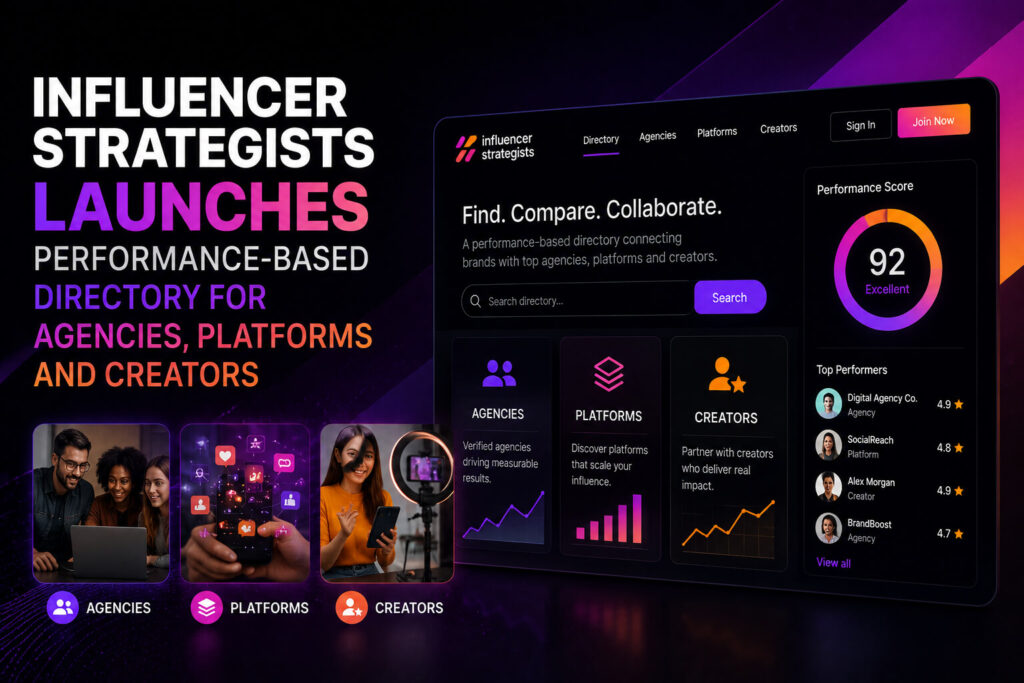
The company has launched a new performance-based directory built to help brands evaluate influencer marketing agencies, technology platforms, and specialist talent using transparent scoring rather than paid placement. The launch centers on the Influencer Power Index, a 100-point scoring framework designed to assess companies based on published criteria and verified evidence.
A Directory Built Around Performance, Not Paid Listings
The biggest point here is simple: Influencer Strategists says the directory is not pay-to-play.
That matters because influencer marketing has become crowded. Agencies want visibility. Platforms want credibility. Creators and strategists want recognition. Brands want proof before they spend. Somewhere in the middle, rankings and directories have become part of the buying process.
Influencer Strategists is positioning its new directory as a more transparent alternative. Its marketplace currently lists agencies, platforms, and influencer experts, with rankings based on performance data and editorial verification. The directory page shows 33 influencer agencies, 21 influencer platforms, and 13 influencer experts listed, with rankings last updated on July 3, 2026.
This is not just another database with company names and contact buttons. At least, that is not the pitch. The point is to make the comparison process more useful for brands that need to know who can actually deliver.
How the Influencer Power Index Works
The Influencer Power Index scores agencies and platforms using a 100-point framework.
For agencies, the scoring areas include Creative Quality, Client Impact, Industry Recognition, and Revenue & Growth. For platforms, the criteria include Product Depth, Customer Proof, Industry Recognition, and Revenue & Growth. Each section is weighted out of 25 points, making the full score easier to compare across entries.
The agency index also states that scores are calculated from documented campaign results, third-party award records, and verified commercial performance. Agencies cannot pay to be listed or influence their ranking, according to Influencer Strategists.
That last part is the hook.
In creator marketing, the gap between a strong campaign and a strong sales page can be wide. A company can look impressive online without offering much proof. This directory is trying to push the industry toward evidence instead of noise.
Client Verification Could Be the Real Difference
One of the more interesting parts of the launch is the client verification system.
When agencies or technology providers submit case studies, clients can independently review campaign details through a unique verification link. Confirmed campaigns receive a Client Verified badge and carry more weight in the scoring model.
That may sound like a small feature, but it hits a real pain point.
Influencer marketing results are often self-reported. Reach, engagement, conversions, earned media value, return on ad spend — all of these numbers can look strong in a case study, but buyers do not always know how much context is missing. A client-confirmed campaign gives brands a little more confidence before choosing an agency or platform.
Not perfect. Nothing in marketing measurement is perfect. But it is better than trusting a glossy PDF with no outside confirmation.
Agencies and Platforms Get Separate Scorecards
Influencer Strategists is not treating agencies and platforms as the same type of business, which is important.
Agencies are judged on areas like creative quality and client impact. Platforms are measured more around product capabilities, customer proof, integrations, AI features, campaign management functions, and business growth.
That separation makes sense. A creator agency and an influencer marketing software company may both sit inside the same ecosystem, but buyers evaluate them differently. One is often about strategy, execution, talent relationships, and creative judgment. The other is about workflow, data, campaign tracking, discovery, reporting, and increasingly, AI-powered intelligence.
Putting them into one flat list would miss the point.
Why This Matters for the Creator Economy
The creator economy is more professional now, but the infrastructure around it still feels uneven.
Brands are not just experimenting with influencer campaigns anymore. Creator partnerships are being tied to full-funnel marketing, commerce, paid media, brand trust, affiliate revenue, and long-term community building. That means partner selection is becoming more serious.
Influencer Strategists describes its broader goal as creating a trusted intelligence layer for the creator economy, where brands can compare agencies, assess technology providers, and identify experienced specialists using consistent evaluation criteria.
That is a big claim, but the need is obvious.
As more marketing budgets move toward creators, brands will want better ways to separate proven partners from loud ones. A performance-based directory will not solve every problem, but it gives the industry a more structured place to start.
More Features Are Coming Later This Year
The Agency Directory is already live with more than 30 scored agencies. The Platform Directory is launching with its first group of technology providers. Influencer Strategists also plans to introduce a directory for individual influencer marketing professionals later in 2026, along with an annual awards program.
That could make the platform more than a directory if it gains enough trust. It could become a reference point for brands, agencies, platforms, and senior creator marketing professionals who want clearer signals in a noisy market.
For now, the launch says something bigger about where influencer marketing is heading.
The industry is moving past vanity metrics. Slowly, unevenly, sometimes reluctantly. But it is moving.
And if brands are going to keep spending serious money on creator campaigns, they will want more than nice screenshots and big promises. They will want proof.