


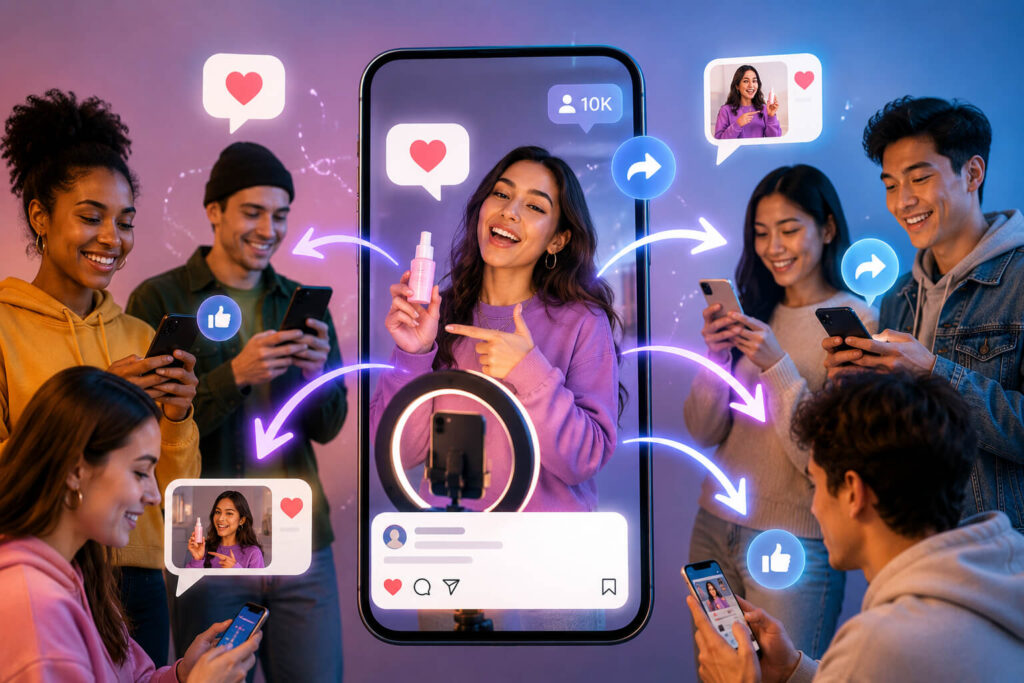
Influencer marketing has always had a simple obsession: find the person with the biggest audience, pay them, post the message, wait for reach. However, developing an effective influencer messaging strategy has become essential as the industry grows more sophisticated.
That still works sometimes. But new research suggests brands may be missing a quieter, more powerful part of the equation.
A study highlighted by the University of Connecticut marketing professor Nicholas Lurie found that influencer campaigns can spread much further when brands do not rely on the influencer alone. The stronger strategy may be pairing a prominent influencer with the right follower — someone already embedded inside that influencer’s community and ready to engage early.
Not a random fan. Not a fake hype account. The right follower.
That distinction matters.
Influencer Plus Follower May Beat Influencer Alone
The research, published in the Journal of Marketing, looked at what the authors call “social affirmation.” In plain terms, people are more likely to engage with a post when they see someone else in the network treating it as valuable.
That is not exactly shocking. Social media has always worked this way.
But the study puts numbers behind it. According to the findings, campaigns using an influencer-plus-follower approach increased the likelihood of posting by as much as fivefold compared with influencer-only campaigns. The same model also improved online word-of-mouth spread by about 80%.
For brands spending heavily on creator partnerships, that is hard to ignore.
It suggests the first few replies, reposts, comments, or shares may not be background noise. They may be part of the campaign engine.
Why Early Engagement Feels More Convincing
A sponsored post from an influencer can feel polished. Sometimes too polished.
But when a follower from the same community engages with that post, the message changes shape. It starts to look less like a one-way ad and more like something people inside the network are already accepting.
That creates a kind of permission signal.
Someone sees the influencer post. Then they see a familiar follower reposting, replying, or backing it up. Suddenly the content does not sit alone. It has social proof attached to it.
The study focused on Korean music-related social media posts, but the researchers said the findings can apply across industries where community opinion shapes behavior. That includes entertainment, fashion, lifestyle, creator-led products, and other categories where taste, identity, and peer validation matter.
For influencer marketing, this is an important shift.
The question is not only “Who has reach?” It is also “Who can make that reach feel credible?”
The Best Follower Is Not Always the Loudest One
The study found that the most useful followers were highly embedded in the influencer’s community. These are people with overlapping connections, shared audiences, and enough visibility inside the network to make their engagement feel meaningful.
That part is easy to overlook.
Brands often look for creators, then stop there. They may track follower counts, engagement rates, audience demographics, and content style. But they rarely map which followers can help validate the message once it goes live.
This research suggests they should.
A follower who is already trusted by the community can help push the campaign further than another large influencer who sits outside that network. Lurie even said that, with a $10,000 social media budget, he would spend it on one influencer and one strategically selected follower rather than two influencers.
That is a very different way to think about campaign planning.
Three Seeded Followers May Be Enough
There is also a limit.
The researchers found that using a small number of selected followers helped amplify the message, but adding too many could reduce the effect. Three seeded followers performed better than four, suggesting that too much coordination may start to look artificial.
And that makes sense.
People can smell over-managed engagement. When every comment arrives too neatly, every reply sounds too supportive, and every repost appears at the perfect time, the campaign starts to lose the thing it was trying to borrow: authenticity.
The better version is more controlled than organic, but not so controlled that it looks staged.
That line is thin. Brands cross it all the time.
What This Means for Creator Campaigns
For influencer marketers, the takeaway is practical.
A creator campaign should not end with choosing the influencer. The next layer is identifying who inside that creator’s audience can help give the message social weight.
That might be loyal fans, niche community voices, smaller creators, discussion leaders, or highly active followers who already shape conversation around the influencer’s content.
This does not mean every brand should start scripting follower reactions. That would probably backfire.
But it does mean campaign teams may need to think more carefully about launch sequencing. Who sees the post first? Who engages early? Which community members can make the message feel real instead of dropped from above?
The influencer is still important. Of course.
But the first wave of follower validation may be what turns a post into movement.
Influencer Marketing Is Becoming More Networked
The old influencer marketing model was simple: one creator, one audience, one campaign message.
This study points to something more networked and less tidy.
Influencer messaging spreads better when the community appears to participate in the message, not just receive it. That is especially relevant now, as audiences become more skeptical of sponsored posts and brands search for better performance from creator budgets.
Bigger reach is not always the answer.
Sometimes the smarter move is finding the right person behind the influencer — the follower who makes everyone else pause and think, “Maybe this is worth sharing.”