


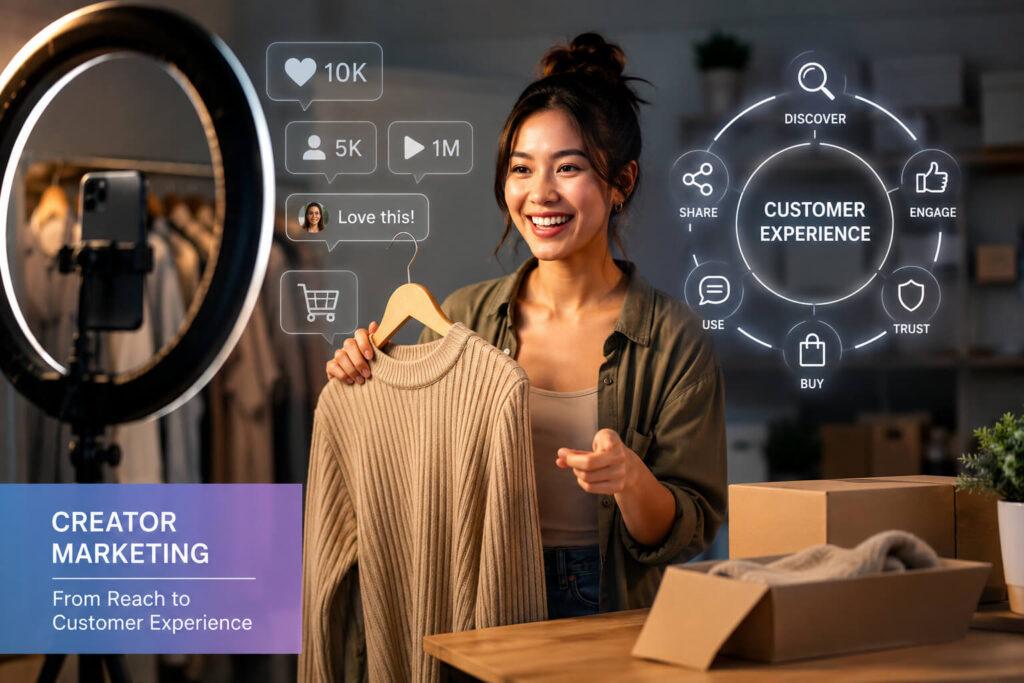
Creator marketing is starting to look less like a campaign tactic and more like part of the customer experience.
That may sound like a small wording change. It is not.
For years, brands mostly treated creators as a way to get attention. More reach. More engagement. More awareness. Maybe a sales bump if the content landed well. The creator came in when the campaign was already built, added a human face to it, and pushed the message into the feed.
That model still exists, of course. A lot of brands still work that way.
But the better creator programs are moving somewhere else.
In a recent episode of CreatorIQ’s Earned podcast, Karthik Suri, Chief Product and Corporate Strategy Officer at Sprinklr, talked about a bigger shift happening inside enterprise marketing. Creators are no longer just posting content around a brand. They are helping shape how customers discover, understand, evaluate, use, and stay connected to products.
That changes the job completely.
Creators Are Becoming Trusted Advisors
People do not only go to creators for entertainment anymore.
People go to creators before buying a product. They turn to them when comparing options. They look for honest proof that something actually works in real life. Sometimes, creators even become the first stop before the brand itself.
That is the uncomfortable part for companies that still see creator marketing as a top-of-funnel activity.
A customer looking for a new skincare product may trust a creator’s routine more than a polished brand page. Someone setting up a gadget may watch a YouTube tutorial instead of reading the official help center. A traveler may trust a creator’s hotel walkthrough more than a booking platform description.
This is where creator marketing starts to touch customer experience.
Creators are not only creating demand. They also shape expectations, reduce confusion, and answer questions brands may not even know customers are asking.
That is powerful. Also risky, if brands are not paying attention.
The Customer Does Not Care About Your Departments
One of the strongest ideas in the discussion is simple: customers do not experience a company in departments.
Customers do not separate marketing from customer care. They are not thinking, “This was a creator campaign, that was a support issue, this was social listening, and that was product feedback.”
They just experience the brand.
A bad support reply can weaken a great campaign. A helpful creator video can save a customer from frustration. A product complaint in a comment section can become a public trust issue before the brand even sees it.
This is why creator marketing can no longer sit in a corner of the marketing team.
It connects to social, customer service, product education, and community. In some cases, creator marketing even reaches product development, because creators and their audiences often surface honest feedback faster than formal research channels.
That is not neat. Real customer behavior rarely is.
Creator Marketing Is No Longer Just About Awareness
Awareness still matters. No one is throwing it away.
But the creator’s role has widened.
Creators can help customers understand how a product fits into daily life. Features become easier to compare when someone explains them in plain language. Mistakes, shortcuts, frustrations, and benefits also feel more believable when shown by a real person instead of a brand. Even after launch, creators can keep a product visible long after the paid campaign budget has moved on.
That matters because the customer journey is messier now.
A person may see a TikTok, search Reddit, watch three YouTube videos, check comments, visit the brand site, leave, come back through an influencer link, ask a question on Instagram, then buy two weeks later.
Where does marketing end there? Where does customer experience begin?
That line is getting harder to find.
CreatorIQ and Sprinklr Point to a Bigger Enterprise Shift
The CreatorIQ and Sprinklr partnership fits into this wider movement. Enterprise brands want creator marketing, social publishing, customer care, paid media, and measurement to connect more cleanly inside one operating system.
That is not just a software story. It is a strategy story.
Big brands are tired of disconnected tools that each show only one piece of the customer. One team tracks creator performance. Another handles complaints. Paid media results sit somewhere else. Support tickets live in a different system, while social sentiment often gets reviewed separately.
Meanwhile, the customer sees one brand.
When those signals are separated, teams move slowly. Patterns get missed. Work gets repeated. Money keeps flowing out without a clear understanding of what is happening around the customer.
A more unified view gives brands a better chance to act with context. Not perfect context. Better context.
And in creator marketing, context is becoming one of the most valuable assets a brand can have.
AI Is Not Just About Generating More Content
AI shows up in nearly every marketing conversation now, sometimes in a very predictable way.
More content. Faster content. Cheaper content.
That is part of it, but it is not the most interesting part here.
For creator marketing, AI may be more useful as a connector. It can help brands understand signals across creator programs, customer support, social conversations, product feedback, and campaign performance. It can help teams see patterns that would be difficult to catch manually.
Which creators are driving trust, not just clicks?
What questions keep coming up in comments?
Where are customers getting confused?
Which communities are shaping purchase decisions before the brand enters the conversation?
Those are not small questions.
Used well, AI can help brands understand the customer journey around creators with more depth. Used badly, it becomes another machine for producing empty content at scale.
The difference comes down to governance, human judgment, and whether brands actually know what they are trying to improve.
The Creator Strategy Is Becoming the Brand Strategy
This is where the shift gets serious.
If creators influence discovery, trust, education, community, purchase decisions, and retention, then creator strategy cannot just be a campaign add-on.
It becomes part of how the brand operates.
That does not mean every company needs to hand over its identity to influencers. That would be lazy. It means brands need to understand that creator relationships now shape how customers experience them in public.
A creator can make a product feel useful. A community can make a brand feel trustworthy. A bad creator partnership can make the whole thing feel forced. Customers notice.
The old question was, “How many people did this creator reach?”
The better question now is, “What role does this creator play in the customer relationship?”
That is a much harder question. It is also the one brands need to ask.
What This Means for Influencer Marketing Teams
Influencer marketing teams may need to defend a bigger seat at the table.
Not by shouting about impressions. Not by reporting vanity metrics with nicer charts. By showing how creators support the full customer journey.
That includes awareness, yes. But also product education, customer confidence, community engagement, feedback loops, retention, and advocacy.
The brands that understand this will treat creators less like rented media and more like relationship builders.
The brands that do not may still get views. They may still get a few viral posts. But they will miss the larger shift happening underneath the creator economy.
Creator marketing is not only about being seen anymore.
It is about being trusted.
Source: Creatoriq