


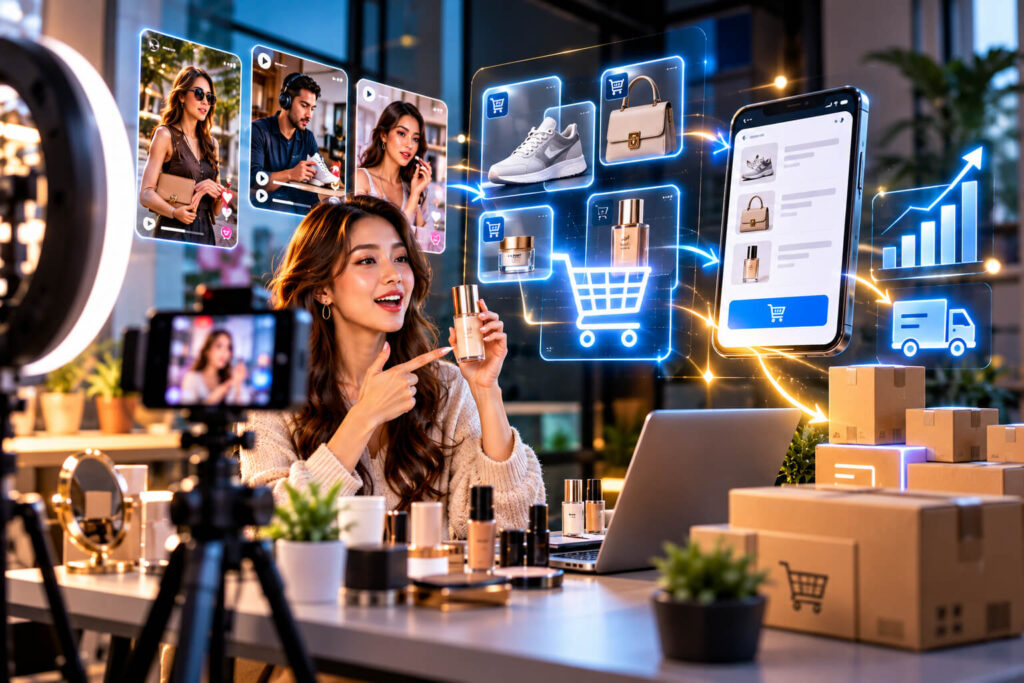
The creator economy has spent years getting very good at generating attention. Now the bigger question is what happens after someone watches.
Across India, social platforms, ecommerce marketplaces and brands are shrinking the distance between a creator recommendation and an actual purchase. Product tags are moving directly into videos. Affiliate programmes are expanding. Retail catalogues are plugging into social platforms. Creators who once relied heavily on sponsorships are also finding more ways to earn from the transactions their content helps generate.
YouTube’s latest Shopping expansion in India captures that shift. Amazon, AJIO, Meesho, Snapdeal and Tata CLiQ are joining the platform’s affiliate programme, widening a merchant network that already includes retailers such as Flipkart, Myntra, Nykaa, Purplle, Shopsy and Tira.
This is no longer just about creator reach. Commerce is being built directly into the content experience.
YouTube Wants the Product Closer to the Video
Affiliate marketing used to ask viewers to do quite a bit of work. They watched the creator, searched for the description, found the right link, opened another page and then decided whether to buy. Each extra step gave the shopper another chance to leave.
YouTube Shopping shortens that journey by allowing eligible creators to attach products directly to their content. Viewers can move from watching a review, demonstration or recommendation to exploring the item being discussed without having to hunt for a separate link.
The platform is expanding this model because shopping behaviour on YouTube is already substantial. Exchange4media reported that shopping-related watch time in India has risen 55% year-on-year, while nearly 450 million logged-in users have made shopping-related searches on the platform.
Creator participation is increasing as well. Enrolment in YouTube Shopping has reportedly grown 200% year-on-year, while average affiliate payouts to Indian creators rose by more than 160% between the first quarter of 2025 and the first quarter of 2026.
Those numbers suggest that YouTube Shopping is moving beyond the experimental stage. It is starting to function as a serious monetisation layer for creators and a measurable sales channel for retailers.
Creator Marketing Is Getting a Harder Performance Metric
Influencer marketing has always had a measurement problem.
Brands can count impressions, views, comments and clicks, but those numbers do not always show whether a campaign actually contributed to a purchase. A video may perform well by engagement standards and still have little impact on sales.
Creator commerce gives brands a more direct metric.
When a creator recommendation is tied to a product tag, affiliate link or trackable storefront, marketers can see more clearly whether the content contributed to a transaction. That makes creator partnerships easier to evaluate alongside other performance marketing channels.
This is particularly relevant for categories such as beauty, fashion, consumer electronics and lifestyle products, where creators already play a large role in product discovery.
The shift also changes how creators can be valued. A smaller creator with an audience that buys may become commercially more attractive than a larger creator who generates attention but little conversion.
Reach still matters. Conversion is simply becoming harder to ignore.
Creators Are Starting to Look More Like Digital Storefronts
Online shopping is no longer always a deliberate journey that begins with a consumer typing a product name into a marketplace search bar.
Discovery now happens while people are watching tutorials, following creators, scrolling through social feeds or seeing products used in everyday content. The shopping journey can begin long before a consumer reaches a retailer’s website.
That puts creators in an increasingly important position.
Exchange4media cited a 2026 Flipkart and Bain & Company report indicating that Gen Z represents roughly 40% to 45% of India’s e-retail shoppers and contributes close to half of incremental e-retail orders. For these consumers, entertainment, social content and product discovery often overlap.
Retailers therefore have an incentive to meet shoppers earlier in that journey.
A fashion brand does not necessarily need a customer to begin inside its own ecommerce app. It simply needs its products to be available when discovery happens elsewhere.
That could be inside a YouTube review, an Instagram post, a creator storefront or a recommendation shared through another social platform.
The storefront is becoming less of a destination and more of a layer attached to content.
YouTube Is Not the Only Platform Building Around Creator Commerce
YouTube may be expanding aggressively, but creator-led shopping is becoming a much broader platform strategy.
Flipkart Group has partnered with Meta to connect Flipkart and Myntra products with affiliate integrations on Facebook, with Instagram expected to play a role as well. The arrangement brings social discovery and ecommerce infrastructure closer together.
Amazon has taken a similar path through its Influencer Program, which allows creators to promote products through platforms including YouTube, Instagram, WhatsApp and Telegram.
The company has also introduced Creator Connections in India, giving brands another way to work with creators on affiliate and performance-based campaigns.
Myntra is pushing into the same space through its Ultimate GlamClan affiliate programme. Creators can build personalised recommendations, storefronts and social content around products, turning their influence into a more direct commerce channel.
The approaches differ from platform to platform, but the underlying strategy is similar.
Creators are increasingly being integrated into the transaction layer rather than being used only at the awareness stage.
Smaller Creators Could Gain More Commercial Weight
The expansion of affiliate commerce could also change how brands think about creator size.
Large creators still have scale, visibility and reach. Those advantages are not disappearing. But performance-based commerce introduces a different question: how effectively does a creator’s audience act on recommendations?
That opens more room for nano and micro creators.
A creator with a smaller but tightly focused audience may have stronger product relevance, greater trust or more concentrated buying intent than a much larger account.
YouTube has lowered the eligibility threshold for its Shopping affiliate programme in India to creators with at least 500 subscribers. That gives smaller channels access to commerce tools much earlier in their development.
For a niche beauty creator, technology reviewer or fashion channel, affiliate revenue can therefore begin before major sponsorship opportunities arrive.
A creator does not necessarily need millions of followers to become commercially useful. They need an audience that responds.
That is a subtle but important shift in how creator value can be measured.
Creator-Tech Platforms Are Building the Infrastructure Behind the Scenes
The visible part of creator commerce is the product tag, recommendation or storefront.
The less visible part is the infrastructure underneath it.
Brands need attribution systems. Creators need reliable tracking. Platforms need to know which creator influenced which sale. Retailers need a way to process commissions accurately. Without that foundation, creator commerce becomes difficult to manage at scale.
That is why creator-tech and partnership platforms are increasingly building around conversion rather than just campaign management.
Impact.com, for example, announced new creator-commerce capabilities in 2026 including Storefronts, creator benchmarking, social amplification tools and planned features designed to reduce attribution leakage during checkout.
This part of the creator economy is less glamorous than viral videos, but it may prove just as important.
If attribution becomes more reliable, brands can spend with greater confidence and creators can receive clearer credit for the sales they influence.
Brands Are Moving From Attention Toward Outcomes
Traditional influencer marketing is not disappearing.
Brands will still pay creators for awareness, storytelling, product launches and cultural relevance. Not every creator post needs to function like an ecommerce page.
In fact, pushing commerce too aggressively could damage the trust that makes creator recommendations valuable in the first place.
Still, the commercial layer underneath creator content is becoming much stronger.
Platforms want more transactions to happen inside their ecosystems. Retailers want their products available wherever discovery happens. Brands want clearer evidence that creator spending produces results. Creators want revenue streams that extend beyond one-off sponsorship deals.
Those interests are beginning to meet around creator commerce.
The next stage of the creator economy may therefore be less focused on how many people saw a piece of content and more focused on what those people did after seeing it.
The checkout is moving closer.
Sources
Exchange4media — Creator economy gets a commerce push as brands move closer to checkout
https://www.exchange4media.com/marketing-news/creator-economy-gets-a-commerce-push-as-brands-move-closer-to-checkout-158578.html
Impact.com — AI and Creator Commerce Innovations at iPX 2026
https://impact.com/press-releases/impact-unveils-ai-creator-commerce-ipx/