


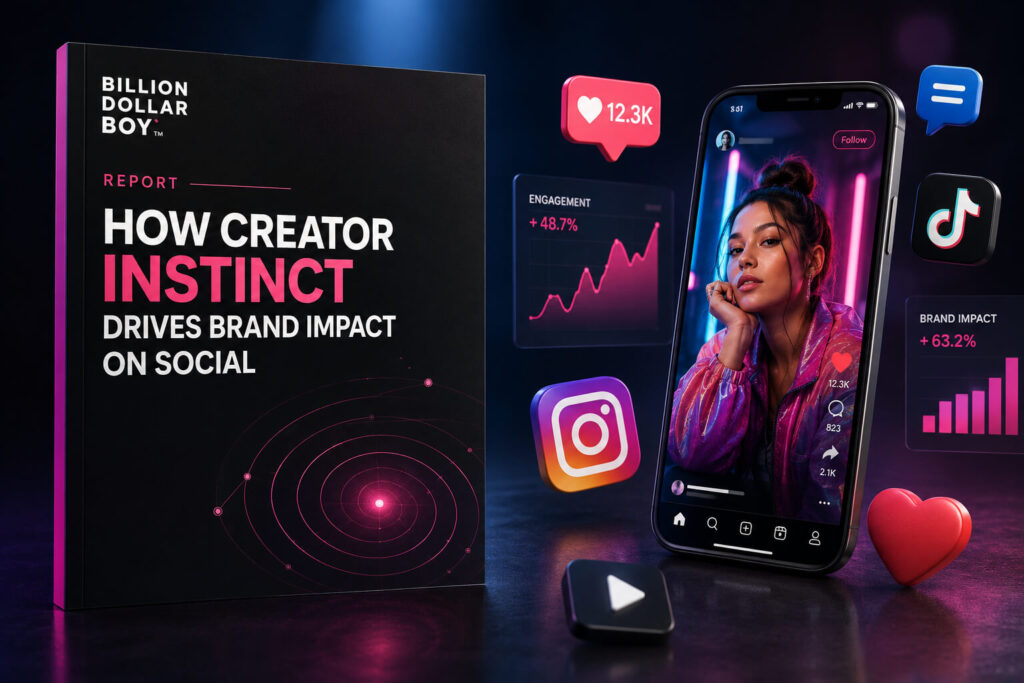
Billion Dollar Boy has released a new research report showing why creator-led content continues to outperform traditional brand messaging on social media.
The report, titled Creator Instinct: Unlocking the Social Code, examines how top-performing creators build attention, emotion, and trust across platforms such as TikTok, Instagram, and paid social. According to the agency, the study analyzed 5,000 creator-led assets across the US and UK to identify what makes social content more effective for brands.
The findings arrive at a time when creator marketing is becoming a larger part of brand strategy. As more businesses invest in creators and influencers, the report argues that success depends less on traditional advertising formulas and more on understanding how creators naturally communicate with audiences.
What Is Creator Instinct?
Billion Dollar Boy describes Creator Instinct as a repeatable framework based on how the best creators make content that connects with people.
Instead of treating creator marketing as simple product promotion, the report suggests brands need to think more like creators. That means earning attention first, building emotional momentum, and placing the brand message at the right moment in the content.
The research looked at key performance drivers including engagement, view-through rate, brand favorability, purchase intent, and consideration intent. It also mapped creator content against emotional signals using attention and emotion tracking technology from DAIVID.
Key Findings From the Creator Instinct Report
One of the biggest takeaways is that creators perform best when they do not introduce the brand message too early.
According to the report, content that leads with the product, benefit, or brand too soon can hurt performance. Billion Dollar Boy found that front-loading the pitch reduced 25% view rates by 44% on both Instagram and TikTok.
This supports a major shift in influencer marketing: audiences do not want to feel like they are watching an ad immediately. They respond better when creators use hooks, storytelling, pacing, and gradual reveals to build curiosity before introducing the brand.
Why “Show, Don’t Tell” Matters in Creator Marketing
The report also highlights the importance of demonstration.
Successful creator content does not simply tell audiences why a product matters. It shows the product in action through tutorials, transformations, real experiences, or entertaining formats.
For creators and influencers, this reinforces a familiar rule: authenticity works best when it is supported by proof. A creator showing how a product fits into their routine can often be more persuasive than a direct sales message.
For brands, the lesson is clear. Creator partnerships should allow room for real use cases, natural storytelling, and platform-native content rather than overly scripted ads.
Emotion Plays a Major Role in Social Performance
Billion Dollar Boy’s research also challenges the idea that one emotional tone works for every category.
The report found there is no universal “effective ad emotion.” Instead, high-performing creator content adapts its emotional style to the category, audience, and platform.
For example, beauty, fashion, food and drink, entertainment, personal care, and retail content may all require different emotional approaches. Some campaigns may benefit from humor or excitement, while others may perform better with honesty, vulnerability, curiosity, or transformation.
This is especially important for influencer marketing teams. Choosing creators based only on reach or follower count is not enough. Brands also need to consider whether the creator’s tone, emotional style, and storytelling approach match the campaign goal.
Playing It Safe Can Limit Brand Impact
Another major insight from the Creator Instinct report is that overly polished content can reduce effectiveness.
Billion Dollar Boy found that creators who show a wider emotional range, including negative or imperfect moments, can drive stronger purchase intent. This suggests that audiences may respond more positively to content that feels real rather than overly controlled.
For brands, this means creator campaigns should not remove all tension, honesty, or imperfection from the final content. In many cases, the realistic moment is what makes the message believable.
Strong Endings Can Improve Purchase Intent and Awareness
The report also emphasizes the importance of “sticking the landing.”
High-performing creator content often builds toward a payoff, such as a reveal, transformation, punchline, emotional climax, or satisfying result. Billion Dollar Boy found that when content ends with a peak of strong positive emotion in the final three seconds, purchase intent increases by 11% and awareness increases by 34%.
This finding is important for both creators and brands. It shows that the timing of the brand message matters. Instead of interrupting the content too early, the brand should be connected to the emotional high point.
What This Means for Brands Working With Creators
Billion Dollar Boy’s research suggests that brands need to update how they approach creator and influencer campaigns.
Rather than forcing creators into traditional ad structures, brands should give them space to use the storytelling techniques that already work on social platforms. The strongest creator content earns attention, demonstrates value, uses the right emotional tone, and delivers a memorable ending.
For marketers, the Creator Instinct report offers a practical reminder: creator marketing works best when it feels like content first and advertising second.
As creator economy ad spend continues to grow, brands that understand how creators build trust and attention may have a stronger advantage on social media.
Final Takeaway
The new Billion Dollar Boy report shows that creator instinct is not just a creative feeling. It can be studied, structured, and applied to brand campaigns.
For creators, the findings reinforce the value of authentic storytelling and emotional timing. For brands, they highlight the need to move away from overly scripted influencer ads and toward content that feels native to social platforms.
In the fast-changing creator economy, the brands that win may not be the ones that advertise the loudest. They may be the ones that learn to think more like creators.