


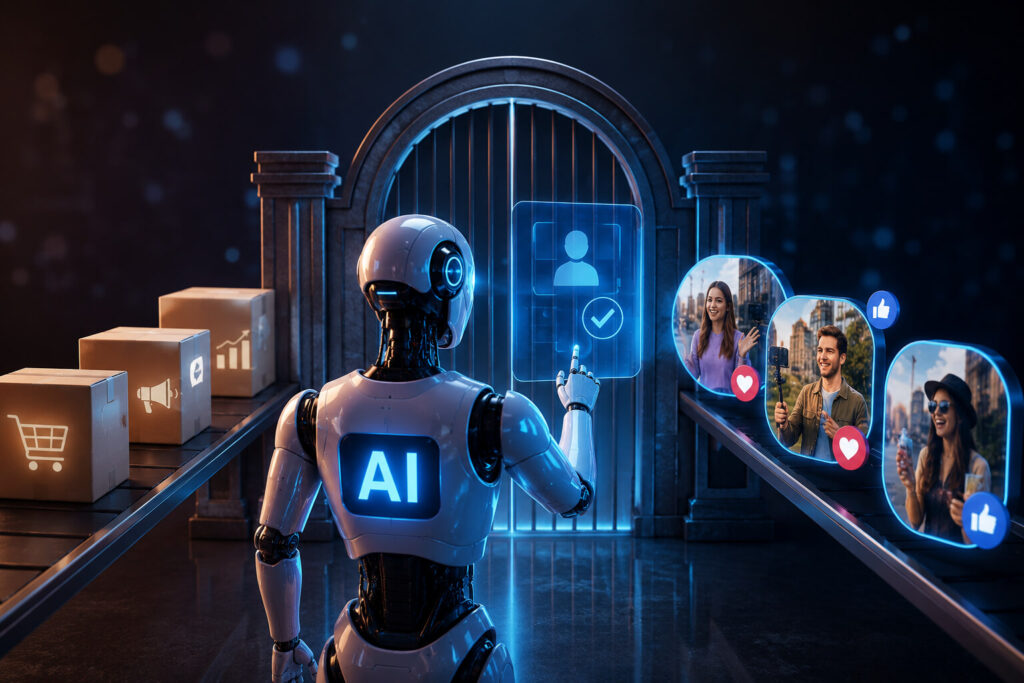
The first person judging an influencer’s pitch may no longer be a marketing manager.
It could be an AI model.
Brands and agencies are starting to use tools such as ChatGPT, Gemini and Perplexity during the earliest stages of influencer discovery. Instead of manually scrolling through social platforms or relying entirely on creator databases, marketers can ask an AI assistant to identify respected creators in a particular industry, location or audience niche.
That small change could completely reshape how influencers are discovered.
A creator may have millions of followers and still be overlooked. Another may have a much smaller audience but appear repeatedly in interviews, articles, podcasts, search results and professional conversations. AI systems can piece together those signals and decide which creator looks more credible.
Follower count is still visible. It is simply no longer the whole story.
AI Is Quietly Building Creator Shortlists
Influencer discovery used to begin with platform searches, agency recommendations and spreadsheets packed with engagement statistics.
Now a brand can ask a question such as, “Who are the most credible food creators in India?” and receive a shortlist within seconds.
That list is unlikely to be based on Instagram followers alone. AI models can examine whether a creator consistently talks about the same subject, appears on reputable websites, earns meaningful engagement and has an identifiable area of expertise.
This means creator discovery is shifting from social popularity toward digital authority.
It also gives AI enormous influence over the beginning of the campaign process. Once an AI-generated shortlist reaches a marketing team, the creators who were not included may never be considered at all.
Creators May Need to Optimise for AI Answers
Search engine optimisation helped businesses become visible on Google. Creators may now need a similar strategy for AI-generated answers.
This does not mean repeating keywords across every profile or posting robotic captions written for algorithms.
The bigger job is making a creator’s expertise easy to understand and verify.
A beauty creator, for example, may need more than product videos and a large audience. Interviews, detailed educational content, media coverage, brand case studies and appearances on other trusted platforms can help establish a clearer professional identity.
AI systems work with information they can find. A creator with strong expertise but a thin public footprint may remain almost invisible to them.
That creates an uncomfortable new reality: creators are no longer producing content only for followers, platforms and brand managers. They are also creating evidence for machines.
A Smaller Creator Could Beat a Celebrity Account
The shift may give niche and mid-sized creators a surprising advantage.
A specialist with 40,000 followers might have a stronger digital reputation than a general lifestyle personality with two million. The smaller creator may be quoted in industry publications, interviewed on podcasts and consistently associated with one recognisable subject.
AI models can connect those references.
They may interpret that creator as a reliable expert, even when the creator is not the largest name in the category.
This is particularly important for brands seeking credibility rather than mass reach. A financial services company may prefer a creator with clear subject knowledge and a documented professional history. A skincare brand may look for someone whose expertise can be confirmed outside a single social media profile.
The loudest creator does not automatically become the most recommendable one.
Digital Reputation Is Becoming Creator Infrastructure
For years, influencer marketing has treated creator reputation as something difficult to measure. Engagement rates, audience demographics and campaign results were easier to place inside a report.
AI changes that calculation.
Models can evaluate signals spread across LinkedIn, YouTube, Reddit, news websites, podcast transcripts, event appearances and other public sources. Together, those references create a type of digital reputation layer.
It is messy. It is not always fair. Still, it is becoming harder for marketers to ignore.
Influencer agencies may eventually spend more time helping creators strengthen this wider presence. Media features, structured profile information, searchable case studies and clearly documented brand partnerships could become part of standard creator management.
The creator’s job is no longer limited to making the post. The surrounding evidence matters too.
Brands Still Cannot Hand Everything to the Algorithm
AI can make discovery faster. It can analyse thousands of profiles and spot patterns that would take a human team days to review.
It cannot fully understand what it feels like to work with someone.
A creator may look perfect in the data and still miss deadlines, misunderstand a brief or struggle during negotiations. Another may appear less impressive on paper but produce unusually strong creative work and build an audience relationship that cannot be reduced to metrics.
Industry leaders have repeatedly warned that AI works best when it supports human decision-making rather than replacing it. Creator platforms are already using AI to analyse content style, sentiment and audience fit, but relationships and creative judgement remain difficult to automate.
Brands will still need people to review the shortlist.
The difference is that AI may decide who reaches that shortlist in the first place.
Visibility Inside AI Could Become a Make-or-Break Metric
Creators already monitor reach, saves, shares, watch time and search rankings.
Soon, another question may become common: does AI recommend me?
There is no simple dashboard for that yet. AI answers can change depending on the model, prompt, location and available sources. A creator might appear in one recommendation and disappear from another.
Even so, brands are paying attention to which people and publications are cited inside AI responses. Forbes reported that marketers are beginning to study the sources AI systems trust when answering product and industry questions.
That behaviour could turn AI visibility into a serious business metric.
Creators who are repeatedly surfaced may receive more inbound opportunities. Those who remain absent may have to rethink how their expertise is presented across the web.
Influencer Marketing Is Moving Beyond the Feed
Social platforms will remain central to creator marketing. Instagram, TikTok and YouTube are not suddenly becoming irrelevant.
The discovery journey is simply expanding.
A marketer might find a creator through an AI answer, verify their work on Google, review their videos on YouTube and finally contact them through an agency or platform. The social feed becomes one step rather than the entire process.
AI is already being used across influencer discovery, campaign planning, content analysis and performance prediction. Industry research also shows that marketers continue to experiment with AI despite concerns surrounding authenticity, trust and technical limitations.
The next phase will not be about replacing creators with machines.
It will be about machines influencing which human creators get seen.
For creators, authority now needs to exist beyond a follower number. Agencies may also need to treat digital reputation as part of talent development. Brands, meanwhile, should treat AI-generated recommendations as a starting point, not a final decision.
The gatekeeper has changed.
Getting through the gate will require more than being popular.
Sources
- Storyboard18 – AI Is Becoming the First Gatekeeper in Influencer Marketing, Say Adtech Founders
- Forbes – AI Is Now Marketing’s Gatekeeper
- Forbes – Influencer Marketing: How AI and Infrastructure Unlock Brand Growth
- Influencer Marketing Hub – The State of AI in Influencer Marketing
- Influencer Marketing Hub – How AI Is Transforming Influencer Marketing