


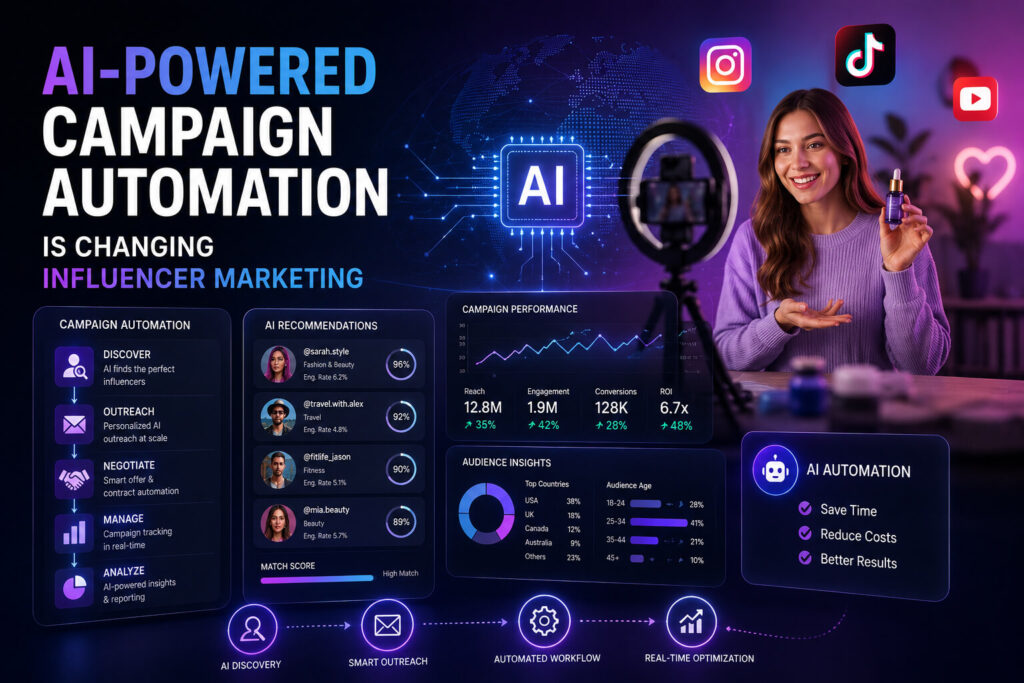
Influencer marketing used to feel a lot more manual than people outside the industry realized. Today, many brands are turning to AI-powered campaign automation to streamline every step of the process. Brands searched for creators, checked profiles, compared engagement, sent emails, followed up, waited, negotiated, tracked posts, collected screenshots, and then tried to figure out whether the campaign actually worked.
A lot of that is now changing.
AI-powered campaign automation is starting to take over the heavy parts of influencer marketing. Not the creative spark. Not the personality. Not the reason people follow creators in the first place. But the slow, repetitive, spreadsheet-heavy work that often sits behind every campaign.
For brands, this means faster decisions. For agencies, it means less time buried in admin. For creators, it could mean more relevant collaborations instead of random pitches that clearly do not match their audience.
Creator Discovery Is Becoming More Precise
Finding the right influencer has always been one of the hardest parts of campaign planning. Follower count alone does not say enough. A creator can have a large audience but weak trust. Another creator may have a smaller community but stronger influence in a niche that matters.
This is where AI is becoming useful.
AI-powered tools can scan creator profiles, audience behavior, engagement patterns, content style, brand fit, and performance history. Instead of choosing influencers based only on surface-level numbers, brands can look deeper into whether a creator actually matches the campaign.
That matters because influencer marketing is not just about reach anymore. It is about relevance. A beauty brand does not only need someone with followers. It needs someone whose audience actually listens, comments, buys, saves, and comes back.
Campaign Management Is Getting Faster
The campaign process itself is also becoming more automated. Briefs, approvals, timelines, deliverables, posting schedules, content reviews, and reporting can now be handled through smarter platforms.
That may sound boring, but it is a big shift.
Campaigns often lose momentum because of small delays. A creator misses a deadline. A brand takes too long to approve content. A manager forgets to update a tracker. A report comes late. None of these things are dramatic on their own, but together, they slow everything down.
AI-powered campaign automation helps keep those moving parts connected. It can remind teams, organize workflows, flag missing deliverables, and make campaign tracking less chaotic.
The result is not magic. It is just cleaner execution. And in influencer marketing, cleaner execution can make a campaign feel much bigger than it actually is.
ROI Tracking Is Finally Getting More Serious
For a long time, influencer marketing had a measurement problem.
Brands liked the attention. They liked the content. They liked the visibility. But when someone asked what the campaign delivered, the answer was not always clear.
AI is pushing the industry toward better ROI tracking. Campaign automation tools can help brands connect creator content to clicks, conversions, sales, engagement quality, audience growth, and other performance signals.
This is important because marketing budgets are under pressure. Brands do not want vague answers anymore. They want to know which creators moved the needle, which formats performed better, which audience segments responded, and which partnerships deserve another round.
Influencer marketing is becoming less about one-off visibility and more about measurable business impact.
Automation Does Not Replace the Creator
There is always one concern when AI enters a creative industry: will it make everything feel fake?
In influencer marketing, that risk is real. Too much automation can make campaigns feel cold, scripted, and painfully obvious. Audiences can spot forced brand content quickly. They know when a creator is just reading a brief.
That is why AI should not replace the creator’s voice. It should support the system around the creator.
The best use of campaign automation is not to make every post sound the same. It is to help brands find better matches, reduce admin work, improve timing, and understand performance more clearly. The creator still needs to bring the story, tone, humor, honesty, and personal connection.
Without that, it is just another ad.
Long-Term Partnerships Could Benefit Most
One interesting part of this shift is what it could mean for long-term brand and creator relationships.
When brands have better data, they can see which creators consistently deliver value. That makes it easier to move away from random one-off campaigns and build stronger partnerships over time.
This is better for creators too. A long-term partnership usually gives them more room to understand the brand, create more natural content, and speak to their audience without sounding rushed. It also gives brands more consistency instead of constantly starting from zero with new influencers.
AI-powered campaign automation could make these relationships easier to manage. It can track past performance, compare campaign results, organize communication, and help brands identify which creators are worth keeping close.
The Industry Is Becoming More Performance-Driven
Influencer marketing is not losing its creative side, but it is becoming more performance-driven. That change was probably unavoidable.
Brands want proof. Agencies want efficiency. Creators want better opportunities. Platforms want smarter targeting. AI sits right in the middle of all of that.
The danger is treating automation as the whole strategy. It is not. A campaign can have perfect data and still fail if the content feels empty. A creator can match every metric and still be wrong for the brand if the audience does not trust the message.
So the real future is probably not AI versus human creativity. It is both working together, sometimes awkwardly, sometimes brilliantly.
What This Means for Creator Marketing
AI-powered campaign automation is changing influencer marketing from the inside. It is making creator discovery sharper, campaign management faster, and ROI tracking more serious.
But the human part still matters most. People follow creators because they feel something: trust, entertainment, inspiration, curiosity, or connection. AI can help brands find that connection more efficiently, but it cannot manufacture it from nothing.
That is the line the industry has to watch.
Automation can make influencer marketing smarter. It can make it faster. It can make it more accountable.
But the best campaigns will still come from creators who know how to make a brand feel like part of a real conversation, not just another scheduled post.