


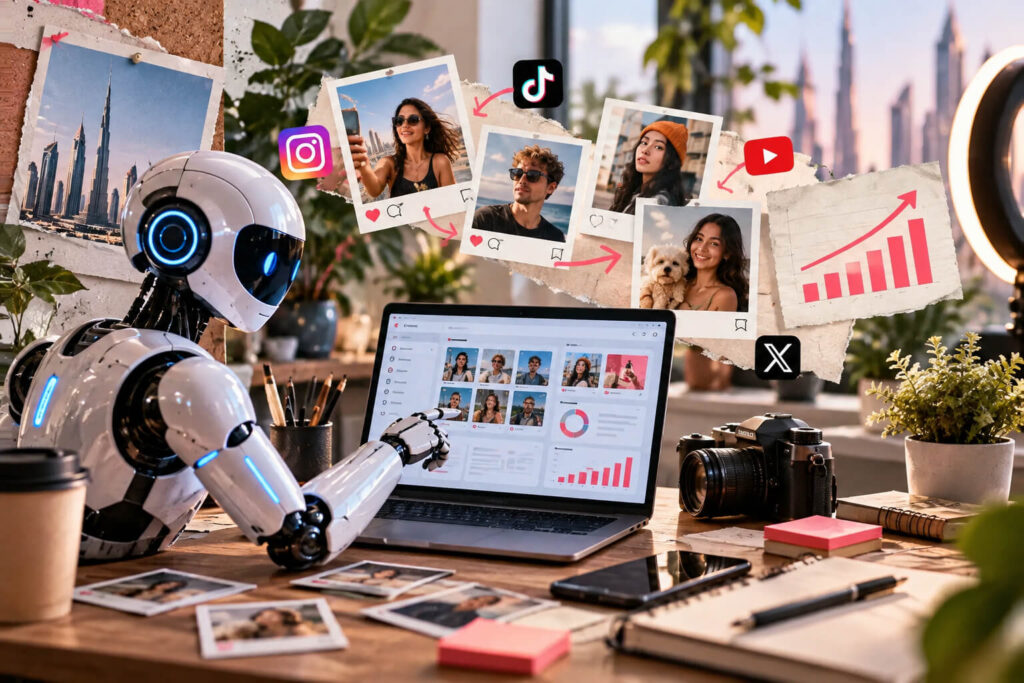
Influencer marketing has a scaling problem.
Running a campaign with five creators is manageable. Running one with 50 gets messy. Push that into the hundreds, across TikTok, Instagram, YouTube and multiple markets, and the familiar mix of spreadsheets, email threads, manual creator research and post-campaign screenshots starts to crack.
That is where AI agents are beginning to change the creator marketing workflow.
Instead of simply helping marketers write captions or search a creator database faster, a newer generation of AI systems is being built to handle connected pieces of a campaign — finding creators, checking brand suitability, managing outreach, reviewing content, monitoring performance and feeding results back into the next decision.
The shift matters because brands are not slowing down their investment in creators. Influencer Marketing Hub’s 2026 benchmark found that only around 10.6% of surveyed marketers said they were not using AI, while creator discovery ranked as the most common application of the technology. The same research found strong intentions to increase influencer marketing budgets this year.
AI is becoming less of an optional productivity tool. For large creator programs, it is starting to look more like infrastructure.
AI Agents Move Beyond the One-Feature Influencer Marketing Tool
Most creator marketing platforms have used some form of automation for years. Search filters can narrow thousands of profiles. Software can calculate engagement rates. Generative AI can draft an outreach message in seconds. AI agents push the idea further by connecting several of those tasks into one continuous workflow.
Rather than waiting for a marketer to manually initiate every individual step, an agent can work toward a broader campaign objective. A team could define the target audience, market, creative direction and budget while the system identifies possible creator matches, reviews their content, ranks candidates and prepares personalized outreach.
That distinction between an AI feature and an AI-driven workflow is becoming increasingly important. Influencer Marketing Hub argues that AI is starting to spread across the entire campaign lifecycle rather than remaining limited to isolated tasks such as writing copy or searching databases.
For marketing teams already stretched by growing creator rosters, that could make scale much easier to manage.
Creator Discovery Is Getting Much More Contextual
Creator discovery is one of the clearest areas where AI can move beyond traditional filtering. Marketers have historically searched by categories, location, follower count, engagement rate and keywords, but those signals do not always show what a creator actually talks about.
A creator listed under fitness might mainly produce running content, bodybuilding videos or home workout tutorials. Someone categorized as a beauty creator might spend much of their time discussing fashion or lifestyle topics instead.
AI systems capable of analyzing videos, captions, imagery, spoken language and on-screen objects can give marketers more context. Swavy, for example, describes its AI creator discovery technology as analyzing actual creator content instead of relying only on profile metadata.
That could allow a sportswear company to find creators who regularly run outdoors rather than searching a broad fitness category. A kitchen brand could identify creators who genuinely cook in their content. A smartphone company could look for creators already producing mobile photography or device-related videos.
The result is a more specific type of creator discovery built around what creators actually make rather than how their profiles are labeled.
AI Can Vet Hundreds of Creators Without Watching Every Video Manually
Finding creators at scale creates another problem almost immediately: someone still has to review them.
Brands need to check audience quality, engagement patterns, previous partnerships, brand suitability and any older content that might create a reputational issue. Doing that manually across hundreds of creators can consume a significant amount of campaign time.
AI-based vetting systems can help by examining audience patterns and identifying signals associated with fake followers or suspicious engagement. Content analysis can also scan previous posts for competitors, sensitive topics, products or imagery that might conflict with campaign requirements.
Influencer Marketing Hub’s 2026 research continues to identify fraud and content quality as concerns for marketers, particularly when campaigns operate across large creator pools.
AI does not eliminate the need for human review because context can still be difficult for automated systems to understand. What it can do is narrow a list of hundreds of profiles into a much smaller group that requires deeper manual assessment.
Creator Outreach Is an Obvious Target for Agentic Automation
Anyone who has managed a large creator campaign knows how quickly outreach can dominate the calendar. Messages need to be personalized, replies tracked, follow-ups scheduled and rates negotiated. Contracts move between several people, while some creators stop responding halfway through the process.
Much of that work is repetitive rather than strategic.
AI agents can help prepare personalized outreach using information from a creator’s recent content, track responses and automatically schedule follow-ups. Some systems can also support negotiations within predefined budget limits while escalating more complicated discussions to a campaign manager.
That becomes particularly useful when brands work with large numbers of nano and micro creators. Those campaigns often depend on volume, and volume creates administrative pressure.
The technology does not necessarily replace creator managers. It changes where they spend their time. Instead of chasing unanswered emails, teams can focus more on creator relationships, campaign strategy and negotiations that actually require human judgment.
AI Is Entering the Creative Review Process Too
Creative review has traditionally been harder to automate because content is subjective. A video may technically follow every campaign requirement while still feeling weak, forced or completely wrong for a creator’s audience.
AI is beginning to play a supporting role here as well.
Systems can compare submitted content with campaign briefs and look for missing brand mentions, disclosure language, calls to action or other required elements. More advanced tools can also examine hooks, pacing, video structure and creative patterns before a post goes live.
For brands coordinating dozens or hundreds of creators at once, that creates a consistent first layer of quality control.
AI can also make briefs more personalized. Instead of sending the same document to every creator, systems can adapt guidance around the creator’s usual format, platform, audience and previous content while keeping the campaign’s core requirements intact.
The creative decision still belongs with the marketer and creator. AI simply removes some of the repetitive checking around it.
Campaign Measurement Could Be Where AI Agents Matter Most
Creator marketing measurement has rarely been elegant. Teams still spend time collecting links, requesting screenshots, confirming whether posts went live and combining performance data from multiple platforms into one report.
AI agents can make that process more continuous.
Relevant creator posts can be detected automatically and performance can be tracked while the campaign is still running. Teams can compare views, reach, engagement, watch time, conversions and other campaign metrics without waiting until everything is finished.
The biggest benefit is not simply faster reporting.
It is the ability to react while the campaign is live. If certain creators or creative formats are performing noticeably better, teams can increase paid amplification, adjust remaining briefs or shift resources toward what is already working.
That changes influencer marketing from something that is launched and reviewed afterward into something that can be optimized while it is happening.
Influencer Marketing Hub’s 2026 benchmark also found strong expectations for increased influencer marketing spending. As budgets grow, measurement becomes more important because bigger creator programs also create bigger reporting problems.
Predicting Creator Performance Is the Next Big Prize
One of the most valuable questions in creator marketing is also one of the hardest to answer: which creator will actually perform well before the campaign starts?
Follower count and engagement rates can offer useful clues, but they are far from perfect. Performance depends on the product, audience, platform, timing, creative concept and even how naturally the creator integrates the brand into their normal content.
AI systems may eventually combine those signals and estimate likely campaign outcomes before a brand commits its budget.
Influencer Marketing Hub describes predictive analytics as one of the emerging areas of AI-powered influencer marketing, although the technology remains imperfect and should not be treated as a guaranteed forecast.
If predictive models become more reliable, creator selection could change significantly. Marketers would not only ask whether someone looks like a good brand fit. They could also estimate how likely that creator is to deliver the outcome the campaign actually needs.
Human Oversight Still Matters
There is a clear risk in automating creator marketing too aggressively.
Creators are people, not advertising inventory. A campaign can become operationally efficient while losing the personality, trust and unpredictability that made creator content effective in the first place.
Automated outreach can feel impersonal. Over-engineered briefs can make every video look the same. Algorithmic scoring systems can also overlook creators whose value does not fit neatly into conventional metrics.
The strongest use of AI agents is therefore unlikely to be complete autonomy.
Human teams still need to approve creator selections, make sensitive brand-safety decisions, handle complex negotiations and judge whether creative work genuinely fits the audience.
AI can handle scale and repetition. People still handle judgment.
Brands Should Start With Their Biggest Bottleneck
Companies do not need to rebuild their entire influencer marketing operation around AI at once.
A better starting point is identifying where the campaign team loses the most time. For one brand, that could be creator discovery. Another may already have a strong creator network but struggle with reporting, while an agency may spend most of its resources on outreach and follow-ups.
Automating one high-friction area makes it easier to judge whether the technology is actually improving campaign performance rather than simply adding another platform to the workflow.
Transparency also matters. If AI recommends a creator, marketers should understand why. If a system flags a possible brand-safety problem, teams should be able to see the content behind that decision.
The same principle applies to rates, rankings and performance predictions. Black-box automation becomes risky when campaign budgets, creator relationships and brand reputation are involved.
AI Agents Could Change the Economics of Influencer Marketing
The biggest impact of AI agents may not come from any single feature.
It may come from making campaigns involving hundreds of creators realistic for teams that previously could manage only a fraction of that number.
Influencer Marketing Hub highlighted an example involving a 227-creator haircare campaign across Instagram and TikTok where Swavy’s platform supported creator sourcing, vetting and campaign measurement through an AI-powered workflow.
That level of scale would normally require substantial manual coordination.
As brands increasingly work with large pools of micro and niche creators, the operational limits of influencer marketing start to matter more. The question is no longer only how much budget a brand has. It is also how many creators, conversations, assets and performance signals a team can realistically manage.
AI agents raise that ceiling.
For creator marketers, the job does not disappear. It moves upward. People handle strategy, relationships, creative judgment and sensitive decisions, while software takes on more of the searching, checking, chasing and measuring underneath.
That may be the real story behind agentic AI in influencer marketing.
It is not about removing creators or marketers from the equation. It is about making a 200-creator campaign feel less like managing 200 separate campaigns.
Sources
Influencer Marketing Hub — How AI Agents Scale Influencer Marketing Campaigns
https://influencermarketinghub.com/how-ai-agents-scale-influencer-marketing-campaigns/
Influencer Marketing Hub — Influencer Marketing Benchmark Report 2026
https://influencermarketinghub.com/influencer-marketing-benchmark-report/
Swavy — AI Creator Discovery
https://swavy.com/platform/ai-creator-discovery